
Every engineer who specifies refractory metal wire eventually confronts the same reality: the material that works perfectly in one application can fail prematurely in another because of a difference in purity, dopant chemistry, or surface condition that no generic datasheet captures. Tungsten wire sits at the center of this challenge. It is not one product. The wire that holds dimensional stability through 1,200°C thermal cycling in a semiconductor ion source is not the same wire that delivers consistent lumen output over 2,000 hours in a halogen lamp, and neither is interchangeable with the wire formed into a vacuum furnace heating element. I have spent more than thirty years producing and testing tungsten wire across these applications, and I can say with confidence that the difference between a reliable production run and a costly field failure almost always traces back to how well the wire grade was matched to the operating environment, not just whether the diameter and tensile strength were correct on paper.
Tungsten wire earns its role in semiconductors, lighting, and heating because it combines properties that no other metal matches simultaneously. It has the highest melting point of any metal at 3,422 degrees Celsius. It retains useful strength at temperatures where nickel and iron alloys have already softened or melted. Its electrical resistivity, roughly 5.5 microhm-centimeters at room temperature, puts it in a practical range for resistive heating while being low enough to carry current efficiently in filament designs. Its low vapor pressure at high temperature means it does not outgas excessively in vacuum or inert-atmosphere processes, which matters enormously in semiconductor wafer fabrication and in sealed lamp envelopes.
These properties are not academic. A heating element designer choosing between tungsten wire and molybdenum wire for a vacuum furnace operating at 1,800 degrees Celsius faces a straightforward decision: molybdenum begins to sag and recrystallize at temperatures where tungsten wire still holds its geometry. A semiconductor equipment engineer specifying filament wire for an ion implanter needs tungsten not for its melting point but because only tungsten wire can be doped to suppress grain growth at the sub-micron level, maintaining precise electron emission characteristics across thousands of wafer processing hours. Each industry pulls on a different combination of tungsten wire properties, and the wire supplied must be optimized for that specific combination.
Semiconductor manufacturing uses tungsten wire in ion implantation, chemical vapor deposition, and physical vapor deposition processes, and the material requirements in this sector are stricter than in any other tungsten wire application. The reason is straightforward: a contaminant that would be invisible in a lighting filament can alter dopant profiles or create particle defects on a wafer surface.
Ion implantation sources use tungsten wire filaments to generate the electron beams that ionize dopant gases. These filaments operate in a plasma environment at temperatures above 2,000 degrees Celsius. The tungsten wire used here typically requires purity of 99.95 percent minimum, with strict limits on potassium, sodium, and iron because these elements migrate to the wire surface under thermal cycling and can sputter onto extraction electrodes or, worse, into the ion beam itself. Wire diameters for ion source filaments commonly range from 0.3 to 1.5 millimeters, with diameter tolerance held to plus or minus 0.01 millimeters because the filament resistance and therefore the electron emission current depend directly on cross-sectional area.
CVD and PVD processes use tungsten wire in evaporation boats and heating coils. Here the wire must withstand not only high temperature but also potential reaction with precursor gases. Tungsten wire with a fine, equiaxed grain structure performs better in these applications because grain boundaries act as diffusion paths, and a finer grain distribution means more uniform material transport when the wire inevitably begins to erode. Semiconductor fabs running high-throughput CVD tools often specify potassium-doped tungsten wire, sometimes called non-sag or W-K wire, because the potassium bubbles that form along the wire axis during processing pin grain boundaries and prevent the catastrophic grain growth that leads to premature filament sagging and resistance drift.
What I tell procurement engineers who are new to semiconductor-grade tungsten wire is to look beyond the purity certificate. Ask for grain structure micrographs from the wire producer. Request lot-specific tensile test data at the operating temperature, not just room temperature. A wire that meets the 99.95 percent purity specification but has uneven grain size distribution will produce inconsistent filament life across a production batch, and that inconsistency shows up as unscheduled tool downtime that costs far more than any price difference between wire grades.
The lighting industry has been the largest consumer of tungsten wire for over a century, and even with the rise of LED technology, tungsten wire filaments remain irreplaceable in several important lighting categories. Incandescent lamps, halogen lamps, and high-intensity discharge lamps all depend on tungsten wire coils that operate at temperatures between 2,500 and 3,000 degrees Celsius.
The fundamental challenge in lamp filament design is that tungsten wire at incandescent temperatures undergoes grain growth that eventually leads to grain boundary sliding, sag, and filament breakage. The lighting industry solved this problem decades ago with the development of doped tungsten wire, specifically potassium-doped tungsten. During the wire drawing process, the potassium inclusions elongate into nano-scale tubes parallel to the wire axis. When the filament heats to operating temperature, these tubes decompose into rows of potassium bubbles that lock grain boundaries in place, creating the interlocking, elongated grain structure that gives non-sag tungsten wire its name. Without this doping technology, an incandescent filament would sag and short against itself within hours.
Halogen lamps push the requirements further. The halogen cycle redeposits evaporated tungsten back onto the filament, but it does so unevenly if the wire surface has imperfections or if the doping distribution is inconsistent. For halogen lamp filaments, wire surface finish becomes a quality parameter that directly affects lamp life. A surface roughness of less than 0.2 micrometers Ra is typical for premium halogen-grade tungsten wire. Coiled-coil filament designs, where the wire is wound into a primary coil and then that coil is wound into a larger secondary coil, demand wire with exceptional ductility and consistent springback properties so that the coiling process does not introduce micro-cracks.
Lighting manufacturers also specify tungsten wire by its recrystallization behavior. Wire that recrystallizes at too low a temperature will lose its non-sag structure before reaching the designed operating point. Wire that recrystallizes too high may remain brittle during the initial forming steps. The recrystallization temperature is controlled primarily by the potassium doping level and the cold-working history of the wire, which means it is a parameter that must be dialed in at the wire production stage and cannot be adjusted by the lamp manufacturer afterward.
Industrial heating represents the third major application domain for tungsten wire, and the requirements here are distinct from both semiconductor and lighting applications. Tungsten wire heating elements operate in vacuum furnaces, hydrogen atmosphere furnaces, and inert gas environments at temperatures from 1,200 to over 2,800 degrees Celsius.
The design challenge for heating elements is fundamentally about balancing resistance with mechanical stability. A heating element made from thin tungsten wire provides high resistance and therefore high heat output per unit length, but thin wire is more susceptible to hot spots, recrystallization embrittlement, and mechanical damage during installation and thermal cycling. Thicker wire or tungsten rod offers better mechanical stability but requires higher current to achieve the same temperature, which increases power supply cost and can create thermal gradients within the furnace hot zone.
In practice, most vacuum furnace heating elements use tungsten wire in the diameter range of 1.0 to 5.0 millimeters, formed into either single-strand or multi-strand configurations. Multi-strand elements, where several thinner wires are twisted or braided together, provide a useful compromise: the individual strands can be thin enough to provide adequate resistance while the bundle as a whole has sufficient mechanical robustness. The trade-off is that multi-strand elements have more surface area per unit mass, which accelerates evaporation at extreme temperatures and slightly reduces element life compared to a single-strand element of equivalent cross-section.
Tungsten wire heating elements for hydrogen atmosphere furnaces require particular attention to the wire purity grade. Hydrogen at high temperature reacts with oxide inclusions in the tungsten, forming water vapor that leaves microscopic voids in the wire structure. Over hundreds of thermal cycles, these voids coalesce and reduce the effective current-carrying cross-section, increasing local current density and accelerating failure. For hydrogen furnace service, tungsten wire with total metallic impurities below 100 parts per million and oxide inclusion content below 50 parts per million is the minimum I recommend, and for furnaces operating above 2,000 degrees Celsius, oxide levels below 20 parts per million are worth the additional cost.
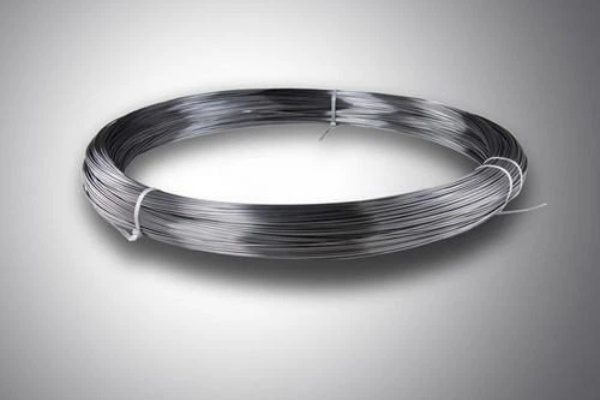
Choosing the right tungsten wire specification means working through several interdependent decisions: purity grade, dopant type and concentration, wire diameter and tolerance, surface finish, and the mechanical properties that matter for your forming process whether that is coiling, bending, or straight-length installation.
| Wire Grade | Typical Purity | Key Dopant | Primary Applications | Diameter Range (mm) |
|---|---|---|---|---|
| Pure (W) | 99.95% min | None | Evaporation boats, some heating | 0.1–5.0 |
| W-K (Potassium-doped) | 99.95% min | 60–100 ppm K | Lamp filaments, ion source filaments | 0.015–1.5 |
| W-Al-K (AKS-doped) | 99.95% min | Al, K, Si | Premium lamp filaments | 0.015–0.5 |
| W-Re (Tungsten-Rhenium) | 99.95% min | 1–26% Re | Thermocouples, high-ductility needs | 0.025–1.0 |
| W-Th (Thoriated) | 99.90% min | 0.5–2% ThO₂ | Electron emitters, TIG electrodes | 0.25–5.0 |
The diameter range column shown above reflects what is commercially available from established tungsten wire manufacturers. For custom applications requiring diameters outside these ranges, a manufacturer with in-house wire drawing capability can often accommodate the request, though minimum order quantities will apply for non-standard sizes.
Surface finish is a parameter that general-purpose wire specifications often omit, but it matters whenever the wire will be coiled or bent to a tight radius. Black finish tungsten wire, which retains the graphite-based drawing lubricant residue, is acceptable for heating elements that will be installed straight. Cleaned or electropolished wire is required for lamp filaments and semiconductor filaments where surface contamination would cause outgassing or particle issues. Electropolished tungsten wire with a mirror finish is the premium grade for semiconductor applications and typically adds 20 to 40 percent to the wire cost relative to black finish.
When I work with a new client who is specifying tungsten wire for the first time, I always ask three questions before discussing price: what is your maximum operating temperature, what atmosphere will the wire operate in, and what forming operations will you perform on the wire before installation. The answers to these three questions narrow the viable wire grades far more effectively than starting from a general specification sheet.
Sourcing tungsten wire for critical production applications requires confirming details that go beyond the datasheet. The wire producer’s quality system matters, but so does the specific production route used for your wire grade.
Diameter measurement method is one detail that creates confusion. Tungsten wire is typically measured either by weight per unit length, expressed in milligrams per 200 millimeters, or by direct diameter measurement using laser micrometers. The two methods do not always agree perfectly because weight-based measurement averages the cross-section along the entire wire length while laser measurement samples at specific points. For wire diameters below 0.1 millimeters, weight-based measurement is the more reliable quality assurance method. For wire above 0.5 millimeters, laser diameter measurement with continuous scanning provides better detection of localized diameter variations. Confirm which method your supplier uses and make sure it matches what your receiving inspection procedures expect.
Spooling and packaging also affect wire usability. Tungsten wire finer than 0.05 millimeters in diameter should be supplied on precision-wound spools with controlled tension to prevent kinking or cross-over that can cause breakage during unspooling. For wire above 1.0 millimeter diameter, coil packaging may be acceptable if the wire will be cut into straight lengths, but coiled wire develops a set curvature that must be accounted for in subsequent straightening operations. I have seen entire shipments of tungsten wire rejected not because the wire itself was defective but because the spooling tension was inconsistent, causing tangles that made the wire unusable in automated filament winding machines.
For semiconductor and lighting applications where wire consistency directly affects production yield, audit your wire supplier’s lot traceability system. Each spool should trace back to a specific ingot or powder batch, a specific swaging and drawing campaign, and a specific set of annealing and cleaning steps. If a filament batch shows an out-of-spec life distribution, lot traceability is what lets you determine whether the root cause was raw material variation or a processing deviation, and it is what lets your supplier implement a corrective action that actually solves the problem.
If your application involves tight diameter tolerance, high surface finish requirements, or a specific doping chemistry, the fastest way to confirm whether a supplier can meet your specification is to share your operating parameters and performance requirements directly. At FOTMA, our team reviews incoming tungsten wire inquiries against thirty years of production data across semiconductor, lighting, and heating grades. We can usually tell within one business day whether a given specification is achievable with standard production routes or requires process development. Send your wire diameter, required purity level, and operating environment details to [email protected] or reach us at +86 13995656368, and we will confirm feasibility and provide a lead time estimate.
s)
Pure tungsten wire is drawn from tungsten that has been refined to 99.95 percent minimum purity without intentional alloying additions. It recrystallizes at a relatively low temperature and forms equiaxed grains that make the wire brittle after first heat-up. Doped tungsten wire contains deliberately added elements, most commonly potassium at 60 to 100 parts per million, that create a stable, elongated grain structure after recrystallization. This structure resists sag and maintains mechanical integrity at operating temperature. Pure tungsten wire is typically used in applications where the wire will not experience sustained high temperature in a configuration that would cause sagging, such as evaporation boats that are supported along their entire length. Doped tungsten wire is required for any unsupported filament or coil application.
Tungsten wire cannot be soldered using standard tin-lead or lead-free solders because tungsten does not wet with these materials. It can be welded, but the process requires careful technique. Resistance welding is the most common method for joining tungsten wire to itself or to other refractory metals. For joining tungsten wire to copper or nickel conductors, crimping or mechanical clamping is preferred over welding because the large difference in melting points and thermal expansion coefficients makes a reliable fusion joint difficult to achieve. In semiconductor filament assemblies, tungsten wire is often mechanically clamped into molybdenum or copper terminal blocks that are designed to maintain contact pressure across the full thermal cycle range.
Tungsten wire filaments fail primarily through two mechanisms: evaporation and grain boundary degradation. At operating temperature, tungsten atoms evaporate from the wire surface at a rate determined by the temperature and the vapor pressure of tungsten. This evaporation is never perfectly uniform. Sections of the wire that run slightly hotter due to local diameter variations or grain structure differences evaporate faster, creating thin spots that increase local resistance, which increases local heating, which accelerates evaporation further. This positive feedback loop eventually causes the thin spot to melt or mechanically fail. Simultaneously, grain boundaries perpendicular to the wire axis act as stress concentration sites and can open into micro-cracks under thermal cycling. Doped tungsten wire delays both failure modes by creating an interlocking grain structure that resists crack propagation and by stabilizing grain size so that evaporation proceeds more uniformly.
Start by defining your maximum element temperature and the atmosphere the element will operate in, because these two factors determine whether tungsten wire is appropriate at all and what purity grade you need. Then calculate the required resistance, which depends on your power supply voltage and the desired heat output. From the resistance and the known resistivity of tungsten at your operating temperature, determine the wire length and cross-sectional area. Select a wire diameter that balances mechanical robustness with the practical constraints of element geometry and power supply current capacity. For vacuum furnaces, a wire diameter of 1.5 to 3.0 millimeters works well for most element designs. For small laboratory furnaces or specialized fixtures, diameters down to 0.5 millimeters may be appropriate. If you are designing an element that will operate above 2,200 degrees Celsius, consider specifying potassium-doped tungsten wire even though doping is more commonly associated with lighting applications, because the non-sag grain structure extends element life at extreme temperatures. Share your element design parameters and operating conditions with our team at [email protected] and we can confirm the optimal wire specification for your specific furnace configuration.
If you’re interested, check out these related articles:
What Is The Most Commonly Used Titanium Alloy
Unveiling Porous Titanium Sheets Properties Applications And Supplier Insights