
Tungsten rod and bar stock occupy a specific niche in high-temperature industry—they are not routine workshop materials but components that engineers turn to when processes exceed 1500°C or when electrode stability under extreme arc conditions matters. Most application guides stop at listing TIG welding and generic heating uses. What they miss are the material-level decisions that determine whether a tungsten rod performs reliably for years or fails prematurely due to recrystallization, grain boundary contamination, or the wrong alloy choice for the thermal cycle. Drawing on more than thirty years of tungsten production and materials engineering, I want to cover the application ground that matters to the engineers and procurement teams who specify these products.
No other commercially workable metal approaches tungsten’s 3422°C melting point. That single property is why tungsten rods and bars appear in vacuum furnace hot zones, glass-melting electrodes, and electron-beam welding cathodes. But melting point alone is not the whole picture. Tungsten retains useful strength at temperatures where molybdenum has already softened and where nickel-based superalloys are far past their service limit. Its low coefficient of thermal expansion and its resistance to creep under load make it a predictable structural material in cyclic heating environments.
We measure these properties against the actual application, not just on a data sheet. A tungsten heating element in a vacuum furnace operating at 2200°C must maintain dimensional stability over hundreds of cycles. If the grain structure is too fine or the material has residual impurity phases from sintering, the element will sag or crack long before the calculated creep life suggests. For this reason, our production team at FOTMA pays particular attention to the powder metallurgy history and final grain orientation when supplying rods for furnace builders.
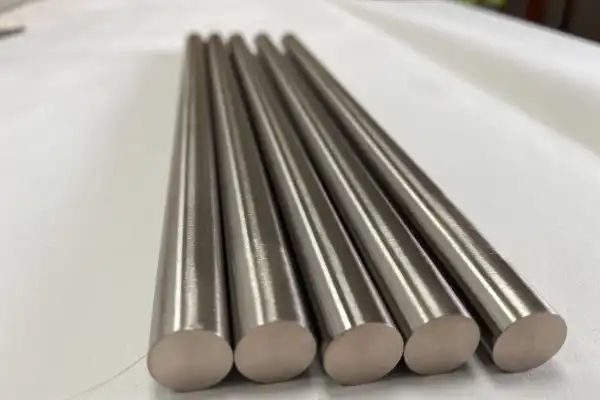
When most engineers think of tungsten electrodes, they picture a TIG torch. That is a core application, and pure tungsten, thoriated, ceriated, and lanthanated grades all have their place. Pure tungsten rods provide stable arc characteristics on AC for aluminum while the rare-earth-doped versions improve electron emission and reduce tip erosion on DC. But the electrode landscape extends much further.
Electron beam welding and melting rely on tungsten cathodes that must maintain a precise emission surface at the tip. Even microstructural changes at the grain boundaries can shift beam focus and reduce weld penetration consistency. We’ve seen this in high-volume aerospace welding cells where a marginal tungsten rod specification—acceptable on paper—leads to unacceptable rework rates because the supplier’s recrystallization temperature was lower than expected. By contrast, discharge lamps and xenon short-arc lamps use tungsten electrodes where the critical parameter is not arc stability alone but resistance to ion bombardment and electrode burn-back, which again depends on grain structure and dopant distribution.
For anyone sourcing tungsten electrodes from China, confirming the starting powder purity and the final grain structure—not just the labeled grade—is the single most productive conversation you can have with a mill.
Tungsten rods serve as direct resistance heating elements and as structural supports in high-temperature furnaces. Their high electrical resistivity compared to copper means they generate heat efficiently when a current passes through them, and their dimensional stability means they do not require frequent adjustment. In vacuum or hydrogen atmospheres, tungsten elements can operate at temperatures where molybdenum elements begin to soften or where graphite would react with the charge.
One of the less obvious application challenges is the formation of coarse, elongated grain structures after prolonged exposure above the recrystallization threshold. When that happens, the element becomes brittle at room temperature, and subsequent handling or thermal shock can cause fracture. We mitigate this by controlling the potassium content and deformation processing during rod manufacturing, which creates a fine interlocking grain structure that resists recrystallization better than standard powder-metallurgy rod.
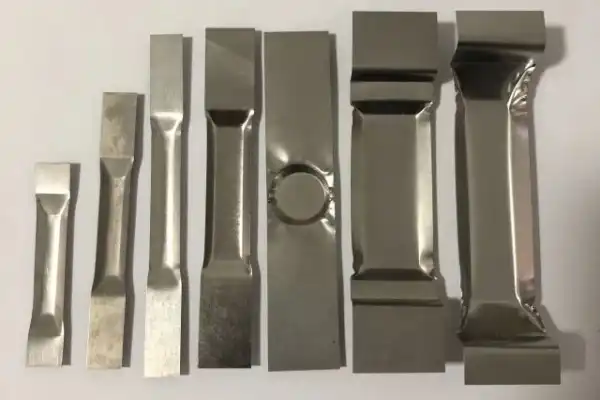
We also supply tungsten evaporation boats and tungsten crucibles where the rod or bar is machined into a shaped heating vessel. These components are used in thin-film deposition and vacuum metallizing. The thermal uniformity of the machined tungsten part directly affects coating consistency. A low-quality rod with internal porosity or uneven density will create hot spots, leading to premature burn-through and contamination of the deposited film.
Not every high-density, high-temperature application requires pure tungsten. Tungsten heavy alloys, typically W-Ni-Fe or W-Ni-Cu with 90–97% tungsten content, are much easier to machine and offer higher toughness while still providing density above 17 g/cm³. For counterweights, radiation shielding collimators, and vibration-damping components, heavy alloy rods are the pragmatic choice. Pure tungsten rod, by contrast, is used when no metallic binder can be tolerated—vacuum furnace elements, glass-melting electrodes, and semiconductor crystal-growing equipment where contamination from nickel or iron would ruin the process.
| Property | Pure Tungsten Rod | Tungsten Heavy Alloy Rod |
|---|---|---|
| Density | 19.3 g/cm³ | 17.0–18.8 g/cm³ |
| Melting point | 3422°C | Lower (binder phase ~1450°C) |
| Machinability | Difficult, requires grinding/EDM | Machinable with carbide tooling |
| Typical doping | Potassium, rare-earth oxides | Ni/Fe or Ni/Cu binder |
| Key applications | Heating elements, TIG electrodes, glass electrodes | Radiation shielding, counterweights, high-density inertial parts |
The choice often comes down to whether the part is structural or functional. A radiation shielding rod can be a heavy alloy and still deliver the required attenuation because density and thickness drive performance. A heating electrode cannot tolerate binder phase evaporation, so pure tungsten is non-negotiable.
If your design sits in a middle ground—say a high-temperature structural component that also carries significant mechanical load—then TZM (titanium-zirconium-molybdenum) alloy rods might be a better fit than either pure tungsten or heavy alloy. We regularly guide clients through this materials triage based on their specific thermal and mechanical boundary conditions.
The gap between a specification sheet and a production lot of tungsten rod is where supply chain reliability is proven. I would argue that three factors separate the consistent supplier from the transactional mill: the traceability of the tungsten powder back to the ammonium paratungstate (APT) stage, the in-house capability to perform both press-and-sinter and subsequent hot working, and the quality system’s ability to catch subsurface defects before shipment.
At FOTMA, we run all tungsten rods through ultrasonic testing and eddy current inspection to detect internal cracks or density variations. This step is often skipped by smaller workshops, yet it is the only way to guarantee that a rod will survive the thermal stresses it will encounter in service. For electron beam welding electrodes and furnace heating elements, we also verify the recrystallization onset temperature on a sample from each lot. That is not a standard ASTM requirement, but we’ve found it is the single best predictor of long-term dimensional stability in the field.
For procurement teams considering China-based tungsten suppliers, verifying ISO 9001 certification and asking for production records that show the full processing route—from powder to final rod—is far more revealing than comparing price alone. A rod that fails early costs far more than the price difference per kilogram.
Not easily. Pure tungsten is extremely hard and brittle at room temperature. It requires diamond grinding tools, wire EDM, or specialized carbide tooling with very low feeds and speeds. Tungsten heavy alloys, by contrast, can be turned and milled with conventional carbide tooling, though tool wear is still higher than with steel. For complex geometries, we often recommend starting with a heavy alloy for machinability and then applying a pure tungsten cladding or insert only where high-temperature performance is needed. If you are planning to machine tungsten rods in-house, investing in the right tooling and coolant strategy will save you from scrapped parts.
Electrode diameter selection depends on the current range and the type of current (AC or DC). A general rule: 1.6 mm (1/16 in) handles up to 150 A on DC, 2.4 mm (3/32 in) up to 250 A, and 3.2 mm (1/8 in) up to 350 A. But the more important factor that gets overlooked is the electrode tip geometry and the cooling efficiency of the torch collet. A poorly ground tip or a collet with insufficient contact area can cause the electrode to overheat and erode at lower currents than expected. For electron beam applications, the cathode diameter is typically larger and the tip must be machined to a precise radius to maintain beam shape.
The two main failure mechanisms are recrystallization embrittlement and grain boundary contamination. Recrystallization occurs when the service temperature exceeds the material’s recrystallization threshold, which can be as low as 1200°C for some grades. The resulting coarse grains and grain boundary impurities cause brittleness. Contamination from oxygen, carbon, or metal vapors in the furnace atmosphere can also attack grain boundaries even below the recrystallization temperature. Using a grade with a higher recrystallization temperature (achieved through potassium doping) and ensuring a clean operating environment will significantly extend rod life.
In the industrial supply chain, both terms are used interchangeably, though “bar” sometimes implies a larger cross-section for further processing, while “rod” suggests a finished product closer to final dimensions. At FOTMA, we define rod as a round product typically from 1 mm to over 200 mm diameter, and bar as the same form in non-round cross-sections. When you are requesting a quote, specifying the exact diameter, length, and surface finish (centerless ground, swaged, or as-sintered) avoids any ambiguity.
Beyond reviewing the mill’s ISO certification, request a certificate of analysis for the specific lot that includes purity levels (minimum 99.95% for pure tungsten), grain structure micrographs, and hardness values. If the application is for furnace heating elements, ask for the recrystallization temperature data. For electrode applications, request emission stability data under your operating conditions if available. A supplier that cannot provide lot-specific data is likely reselling material from multiple sources with inconsistent quality. Share your requirement with us at [email protected], and we will provide the testing documentation relevant to your application before you commit to an order.
If you’re interested, check out these related articles:
How To Choose A Qualified Molybdenum Rod Supplier
All You Need To Know About Copper Nickel Alloy Suppliers
What Are The Uses Of Molybdenum Rod
Thomas Mitchell S Successful Shopping Experience
Unveiling The Wonders Of Titanium Foil A Comprehensive Guide