
TZM molybdenum alloy combines molybdenum’s high melting point with titanium and zirconium additions that raise recrystallization beyond 1900°C, making it a workhorse for vacuum furnace hardware and aerospace thermal structures. Yet performance depends heavily on form—rod, sheet, or foil—and the associated grain direction. As a materials engineer, I’ve repeatedly seen procurement teams order the right alloy but the wrong product shape, leading to premature part failure. This article sorts through the form selection logic, compares TZM to pure molybdenum at temperature, and highlights what to specify when buying mill products so you get material that survives the high-temperature job.
TZM is a powder-metallurgy molybdenum alloy with approximately 0.5% titanium, 0.08% zirconium, and 0.02% carbon. The alloying elements form fine carbide and oxide dispersions that pin grain boundaries, suppressing recrystallization. This gives TZM a recrystallization temperature roughly 330°C higher than unalloyed molybdenum, translating to useful mechanical strength above 1400°C where pure Mo would soften and deform. I routinely recommend TZM for hot zone structural parts—heating element supports, thermal shield frames, and sintering boats—that must hold shape across hundreds of thermal cycles. The trade-off is that TZM retains molybdenum’s poor oxidation resistance, so it still needs vacuum, hydrogen, or inert atmosphere protection.
for Spraying)
When I walk into a customer’s project review, the first question is usually about alloy grade—but the second, and often more impactful, is about product form. The same nominal TZM chemistry performs quite differently as forged rod, cross-rolled sheet, or thin foil, because the thermomechanical processing history determines grain orientation and, consequently, anisotropic mechanical properties.
Forged or swaged TZM rod and bar stock are the materials of choice for round symmetrical parts that see multi-axial stress: heating element supports, furnace rack columns, and rotating shafts in high-temperature actuators. The forging process refines the grain structure uniformly in the radial direction, giving the best combination of creep resistance and fatigue life when loads come from multiple directions. In my experience, for a furnace support post that carries a heavy heating element assembly, a turned TZM rod with a stress-relief anneal at 1200°C outperforms a similar section cut from plate simply because the microstructure is more isotropic. We stock TZM rod from 6 mm to 80 mm diameter, with ground surface finish options.
s)
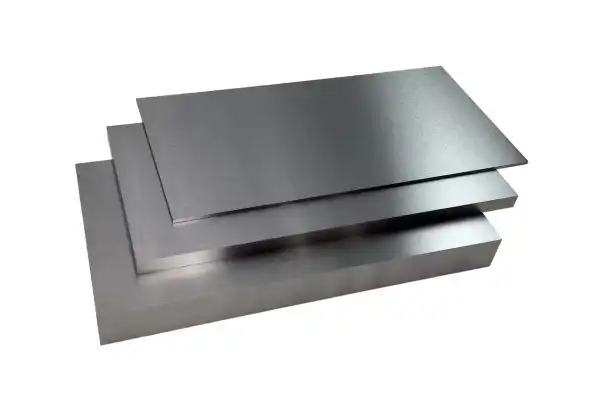
When the part is a flat structural component—thermal shield panels, hearth plates, or base plates for sintering trays—TZM sheet and plate are the correct forms. The rolling process aligns grains in-plane, which boosts strength and stiffness along the length and width but reduces through-thickness properties. This directional strength is beneficial for thin-walled structures that must span a distance under load, but engineers need to orient the part correctly relative to the rolling direction. I’ve seen cracking occur in a large shield panel because the load was applied perpendicular to the rolling plane, where ductility is lowest. For critical structural applications, we can supply cross-rolled TZM sheet that approximately balances in-plane properties, at a modest cost premium.
TZM foil, typically from 0.025 mm to 0.5 mm thick, serves thermal barriers, corrugated heating element windings, and flexible metallic seals in high-temperature instrumentation. At these thicknesses, the material’s high-temperature stability is critical because even minor grain growth can cause local thinning and hotspot formation. Our mill can supply TZM foil down to 0.025 mm with a clean surface and tight thickness tolerance, which is essential for consistent electrical resistance in heating circuits. One tip from production: for foil that will be wrapped around a mandrel, specify a minimum bend radius of 2t to avoid micro-cracking, especially if the material has been cold-worked.
If your high-temperature process involves a mix of structural and thin-gauge TZM parts, it’s worth confirming the exact mill form and grain direction before issuing a purchase order. Contact our team at [email protected] to discuss your application—we’ll flag the right starting stock for your machining route.
Cost pressures often push engineers toward pure molybdenum, but there are clear thresholds where TZM pays back. Pure molybdenum recrystallizes around 1100–1200°C, losing its worked strength and becoming brittle at room temperature after cooling. TZM pushes that threshold beyond 1400°C. So for a furnace that cycles between 800°C and 1300°C, pure Mo hot-zone hardware might need replacement every few months, while TZM components last several years. That difference alone offsets the higher material cost.
| Property | TZM Alloy | Pure Mo |
|---|---|---|
| Recrystallization temp | ~1400°C | 1100–1200°C |
| Tensile strength at 1000°C | ~400 MPa | ~250 MPa |
| Typical high-temp use | Up to 1700°C (inert atm) | Up to 1500°C |
| Cost factor | ~1.3–1.5× | base |
I’ve analyzed this trade for an aerospace heat treating furnace: upgrading a pure Mo heating element suspension frame to TZM extended the service interval from 4 months to over 24 months, saving labor and downtime. However, if the application never exceeds 1100°C and has limited cycles, pure molybdenum is usually adequate.
Sourcing TZM from a reliable mill matters because small compositional variations or improper sintering can degrade high-temperature performance. I recommend looking for:
For customers importing from China, we’ve found that tight thickness tolerances on sheet (±0.05 mm) and good flatness are achievable with proper rolling practices. Check whether the supplier uses cross-rolling to reduce anisotropy if your part will see biaxial stress. Lead times for standard TZM rod and plate from our facility are usually 2–4 weeks; custom dimensions take longer. Minimum order quantities start at a few pieces for small diameters.
Selecting TZM alloy mill products is not just about checking a box for ‘high-temperature’—the form, grain direction, and processing history directly determine whether the part survives or fails in service. If you’re currently designing a high-temperature component and want to confirm that your material specification is right for the job, send your part drawing and service conditions to [email protected] or call +86 13995656368. We’ll review the form selection, tolerances, and any special surface requirements so your material arrives ready for machining.
TZM is non-magnetic, like pure molybdenum. It can be used in applications where magnetic interference must be avoided, such as in certain vacuum tube components.
TZM can be electron-beam welded in vacuum with moderate success, but it is more difficult to weld than pure Mo due to its higher strength and tendency to crack along grain boundaries. For structural joints, I recommend mechanical fastening or designing integral features to avoid welding if possible. If welding is required, preheating above 400°C and slow post-weld cooling reduces cracking risk.
In non-oxidizing atmospheres, TZM can operate up to 1700°C, though creep becomes significant above about 1500°C. For vacuum furnaces, 1500°C is a practical upper limit for heavily loaded structural parts. TZM melting point is around 2620°C but strength is negligible long before melting.
TZM offers a higher strength per unit weight and better machinability than tungsten heavy alloy at temperatures above 1000°C, but tungsten alloys provide higher density and better X-ray shielding. For pure thermal stability without weight constraints, TZM is often preferred. If your project requires a specific high-temperature performance benchmark, our materials engineers can help you decide between TZM and tungsten alloy based on your exact requirements—reach out with your parameters at [email protected].
If you’re interested, check out these related articles:
What Is The Most Commonly Used Titanium Alloy
Titanium Foil Wide Application Of High Performance Metal Materials
Comprehensive Applications Of Tungsten Copper Alloy In Aerospace And New Energy Vehicles