
When a design requires the extreme density of a tungsten heavy alloy, whether for radiation shielding, a counterweight, or a kinetic energy penetrator, the binder system is not an afterthought. The choice between a nickel-iron (W-Ni-Fe) and nickel-copper (W-Ni-Cu) binder directly determines magnetic behavior, machinability, and corrosion resistance. More than three decades of producing these alloys at FOTMA have taught me that the wrong binder selection causes more field failures than raw material defects. This article breaks down the performance trade-offs and production realities so you can select the right grade without relying on textbook generalities.
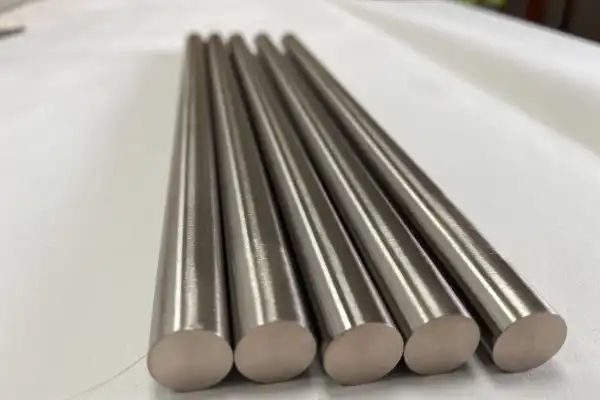
In powder metallurgy, tungsten powder is mixed with a binder (typically Ni-Fe or Ni-Cu) and liquid-phase sintered at about 1,500°C. The binder fills the spaces between tungsten grains, reducing porosity and enabling net-shape machining. Standard ASTM B777 defines grades by tungsten content (90 to 97%) and binder type. Without the binder, pure tungsten is too brittle for most structural applications. The binder composition, not just tungsten content, dictates magnetic response and environmental durability.
The binder forms a ductile matrix around tungsten grains during sintering, allowing the alloy to achieve near-theoretical density (17.0 to 18.8 g/cc depending on tungsten content). This matrix imparts toughness and makes the alloy machinable, unlike pure tungsten which requires grinding. Without a binder, the material would have zero ductility.
Ni-Fe binder results in an fcc matrix with small amounts of intermetallic phases that make the alloy ferromagnetic. Ni-Cu binder forms a more homogeneous fcc solid solution that remains non-magnetic. The copper addition reduces the solubility of tungsten in the liquid phase slightly, which can affect density uniformity if sintering parameters are not tightly controlled. In our production, achieving full density in W-Ni-Cu requires stricter process windows than W-Ni-Fe for the same tungsten content.
W-Ni-Fe alloys exhibit relative magnetic permeability values typically between 1.02 and 1.20, depending on composition and heat treatment. This is enough to interfere with MRI or sensitive electron beam equipment. W-Ni-Cu, by contrast, consistently measures permeability below 1.002, essentially non-magnetic, making it the mandatory choice for medical imaging counterweights, magnetic shielding, and electronics packaging where even weak ferromagnetism cannot be tolerated.
| Property | W-Ni-Fe (Class 1, 90W) | W-Ni-Cu (Class 1, 90W) |
|---|---|---|
| Density (g/cc) | 17.0 | 17.0 |
| Tensile Strength (MPa) | 900–1000 | 800–950 |
| Elongation (%) | 8–15 | 3–8 |
| Hardness (HRC) | 24–28 | 26–30 |
Ni-Fe alloys offer significantly higher elongation, absorbing more energy before fracture, which is critical for impact-loaded counterweights and penetrator applications. Ni-Cu grades, being harder and less ductile, are more prone to edge chipping during machining but deliver better compressive strength in static applications.
Ni-Cu alloys generally outperform Ni-Fe in chloride-containing atmospheres and mild acids because the copper content stabilizes the passive film. Ni-Fe binder can undergo selective corrosion at grain boundaries if exposed to humid, saline conditions over long periods. We have encountered cases where a W-Ni-Fe radiation shield stored in a coastal environment developed surface rust within months, while a W-Ni-Cu part in the same environment remained intact. For components shipped through sea freight or installed offshore, this difference becomes a specification-level concern.
If your part will see salt-spray exposure or requires a guaranteed non-magnetic reading below 1.002, the raw material certification alone may not catch process-induced variations. Our metallurgical team can review your specification against production control data. Reach us at [email protected].
Based on three decades of machining tungsten alloys, I have seen that W-Ni-Fe is the more forgiving grade in CNC turning and milling. The softer, tougher binder creates continuous chips that are easier to break and evacuate. W-Ni-Cu’s harder matrix produces short, brittle chips and higher tool wear. Achieving tight tolerances (±0.05 mm) on complex geometries with W-Ni-Cu demands rigid fixturing and sharp carbide inserts with controlled feed rates.
Another subtle issue is density gradients. W-Ni-Cu’s lower tungsten solubility in the binder can lead to micro-porosity if the cooling rate after sintering is not carefully managed. In our production, we use post-sintering inspection to ensure minimal density variation before releasing material for machining.
Selecting the wrong binder grade can lead to magnetic interference, premature corrosion, or machining scrap that doubles your lead time. The decision should not be left to a general catalog cross-reference. FOTMA has produced both W-Ni-Fe and W-Ni-Cu alloys for aerospace, medical, and defense programs, and we apply that production history to help you specify the right material the first time.
Send your part geometry, required tungsten content, and any environmental or magnetic constraints to [email protected], or call +86 13995656368. We will confirm the most suitable grade and provide a quotation based on your quantity.
Yes. Even the low magnetic permeability of W-Ni-Fe can cause image artifacts in MRI and is generally unacceptable near the bore. Medical device OEMs almost always specify W-Ni-Cu for non-magnetic assurance. If your part is a structural component near an imaging field, insist on a certified permeability test report with every batch.
It is possible, but the lower elongation means you must design for brittle failure modes. For applications like crankshaft counterweights or ballistic parts where a crack can be catastrophic, W-Ni-Fe’s 8–15% elongation provides a safety margin that W-Ni-Cu often cannot match. When impact is the primary load, we recommend W-Ni-Fe with appropriate corrosion protection if environmental exposure is a concern.
The copper binder requires tighter process control to achieve full density and avoid porosity, which increases production cost. Additionally, the narrower sintering window may result in higher scrap rates for complex shapes. At FOTMA, we optimize the manufacturing route for each grade to balance performance and cost, but W-Ni-Cu typically carries a 10–15% premium over W-Ni-Fe at the same tungsten content.
We keep common sizes of both W-Ni-Fe and W-Ni-Cu in inventory, but for custom profiles or large orders, we produce to your drawing. The choice of binder does not extend lead times significantly once the process is qualified. Share your requirements and we will confirm stock availability and production schedule. Email [email protected] with your drawing and quantity.
If you’re interested, check out these related articles:
Beyond Price The Ultimate Guide To Choosing Your Titanium Supplier Parts Manufacturer
Breaking Through The Performance Limit Of Titanium Alloys The Intrinsic Fracture Toughness Of Titanium