
When evaluating tungsten heavy alloy grades for a design, the difference between 90% and 97% tungsten content often comes down to a few tenths of a gram per cubic centimeter on a data sheet. Yet that difference cascades into real-world trade-offs in machinability, cost, and component durability. As a materials engineer with three decades of production experience, I’ve seen how the wrong grade choice can delay projects and inflate machining costs. This article compares the properties, applications, and sourcing considerations of 90% and 97% tungsten alloys to help procurement teams and design engineers make an informed decision.
Both grades belong to the ASTM B777 family of tungsten heavy alloys (WHA), typically using a nickel-iron or nickel-copper binder phase. The key difference is the tungsten fraction: 90% WHA contains roughly 10% binder by weight, while 97% WHA reduces the binder to about 3%. That compositional shift drives nearly every performance variable.
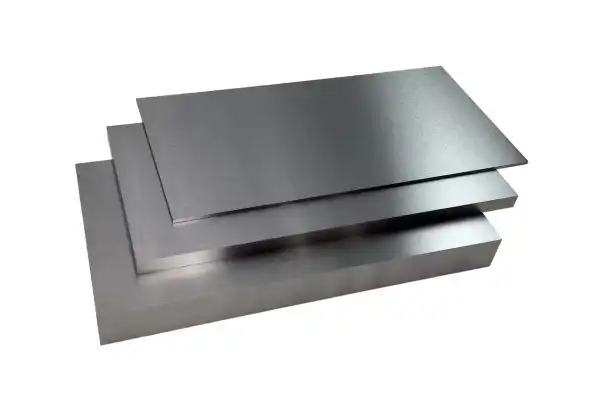
| Property | 90% WHA (Class 1) | 97% WHA (Class 4) |
|---|---|---|
| Nominal density | 17.0 g/cm³ | 18.5 g/cm³ |
| Hardness (HRC) | 24–28 | 28–32 |
| Tensile strength (MPa) | 600–800 | 650–850 |
| Elongation (%) | 5–15 | 1–5 |
| Magnetic | W-Ni-Fe: yes | W-Ni-Fe: yes; W-Ni-Cu: no |
| Machinability | Good | Fair to poor |
The density difference is about 8.8%. For the same volume, a part that weighs 1.0 kg in 90% WHA will weigh roughly 1.09 kg in 97%. In space-constrained applications like an aircraft balance weight pocket or a radiation collimator bore, that extra mass can eliminate the need to redesign surrounding structures. For a broader look at tungsten alloy properties, see our guide on Tungsten Alloy Properties: Density, Hardness & Machinability.
The higher tungsten content in 97% WHA increases hardness and ultimate tensile strength modestly, but elongation drops by a factor of three or more. In practical terms, 97% WHA is less forgiving under impact and more likely to chip or crack during secondary operations. We routinely advise customers that 97% WHA requires slower feed rates, rigid setups, and sharp carbide tooling. Even then, scrap rates for complex geometries with thin walls or sharp edges run higher than with 90% WHA.
If your program involves parts that combine tight tolerance and 97% WHA, it is worth confirming the machining strategy early. Our engineering team can review your design for manufacturability at [email protected].
Yes, but only with the right process. Carbide grades with high cobalt content and low cutting speeds are standard. Coolant is necessary to prevent micro-cracking. For high-value production runs, we often recommend factoring in 10–15% extra raw stock for tooling trials compared to 90% WHA.
90% WHA is the workhorse for most commercial and medical applications. Its combination of good machinability, moderate hardness, and cost efficiency makes it the default choice for medical radiation shields, industrial counterweights, golf club heel/toe inserts, and vibration-damping masses. When the design allows a slightly larger volume, 90% delivers consistent performance without the machining headache.
Another overlooked advantage: using a W-Ni-Cu binder turns 90% WHA non-magnetic, a requirement for certain MRI components and electronic packaging. This is far harder to achieve with 97% grades because the reduced binder fraction limits the copper’s influence on permeability.
For nuclear medicine source containers, military penetrators, and high-end aerospace counterweights that live in tightly volume-constrained locations, 97% WHA justifies its cost premium. That premium often runs 20–40% above 90% WHA, driven both by raw material cost and the lower yield from machining. The reward is a component that provides maximum inertia or attenuation without exceeding the envelope.
In programs where the part is relatively simple — solid cylindrical slugs, for instance — 97% WHA poses less machining risk. The trouble starts when you add tapped holes, undercuts, or thin flanges.
No matter which grade you choose, batch-to-batch consistency matters. A supplier that controls powder particle size and sintering parameters produces uniform density and predictable machinability. At FOTMA, we have been manufacturing tungsten heavy alloy components for over 20 years under ISO certification, with in-house testing to verify composition and mechanicals on every lot.
If you are working on a design that hinges on getting the density-cost-machinability balance right, send your part drawing and quantity to [email protected] or call +86 13995656368. We can provide an engineering review and a quotation based on your target grade and tolerances.
It depends on your space constraint. 97% WHA provides about 9% more attenuation per unit thickness, so for a scanner collimator where every millimeter matters, that advantage is decisive. For larger-area shielding or mobile equipment where a few extra centimeters are acceptable, 90% WHA delivers nearly equivalent protection at lower cost and better machinability.
It depends on the binder. W-Ni-Fe grades are magnetic regardless of tungsten content. W-Ni-Cu grades are non-magnetic. Most standard 97% WHA is supplied with a Ni-Fe binder because copper-based alloys are harder to sinter to full density at high W fractions. If non-magnetic is mandatory, 90% WHA with a Cu binder is the safer route.
Typical lead time for machined components in 97% WHA is 4–6 weeks from drawing approval, assuming standard geometries. Parts with complex tolerances or thin sections may require an extra week for process qualification. We recommend engaging the supplier early to align on machining strategy and inspection criteria.
Yes. Nickel, chrome, or oxide coatings are commonly applied to WHA for corrosion resistance or cosmetic finish. The binder phase can require a specific surface preparation to ensure adhesion. Specify your coating requirement during quoting so the surface finish can be factored into the machining step.
If your application requires a specific grade, non-magnetic binder, or coating — or if you are still weighing the trade-offs — share your requirements at [email protected] and we will confirm the feasibility and lead time for your part.
If you’re interested, check out these related articles:
Chinas Titanium Industry Breaks Through To High End Development
What Is A Titanium Rod Used For