
When an application calls for high density or extreme temperature resistance, the conversation almost always lands on tungsten. But the moment a drawing arrives, the real question surfaces: can this part actually be machined from pure tungsten, or does it need a tungsten alloy? Pure tungsten gives you a melting point of 3422°C and a density of 19.3 g/cc, numbers that dominate any comparison chart. What those charts rarely show is how the material behaves when a CNC tool touches it. After three decades producing both pure tungsten and tungsten heavy alloy parts for global OEMs, I have seen the same pattern repeat: engineers specify pure tungsten for its theoretical maximum properties, then revise the specification once they understand what machining it actually costs. This comparison goes beyond density tables to the manufacturing reality that determines whether your part ships on schedule.
Pure tungsten is a refractory metal with the highest melting point of any metal at 3422°C. Its density of 19.3 g/cc makes it one of the heaviest engineering materials available. These two properties alone explain why it shows up in vacuum furnace heating elements, evaporation boats, TIG welding electrodes, and sputtering targets. In high-temperature, high-vacuum environments, nothing outperforms it.
But pure tungsten has a structural weakness that data sheets rarely emphasize: it is brittle at room temperature. The material has a ductile-to-brittle transition temperature above ambient, meaning that under normal handling and machining conditions, it behaves more like a ceramic than a metal. It does not deform before fracture. If you apply too much cutting pressure or the wrong tool geometry, the part does not bend. It cracks or chips at the edge.
This brittleness is not a manufacturing defect. It is intrinsic to the body-centered cubic crystal structure when no secondary phase is present. For applications where a simple rod, plate, or electrode shape is needed and minimal post-sinter machining is required, pure tungsten works. The moment the part requires threading, undercuts, complex profiles, or tight tolerances achieved through cutting rather than grinding, pure tungsten becomes a manufacturing challenge that adds real cost and lead time.
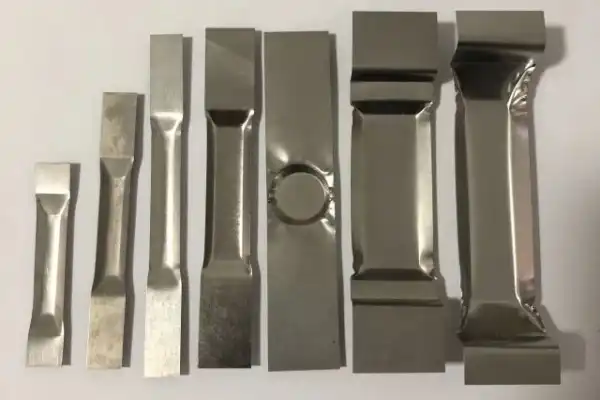
Tungsten heavy alloy, often called WHA or simply tungsten alloy, is not a single material. It is a family of two-phase composites produced by liquid-phase sintering of tungsten powder with a lower-melting binder metal. The most common binder systems are nickel-iron and nickel-copper, with tungsten content ranging from 85% to 97% by weight.
The binder phase solves pure tungsten’s fundamental problem. By surrounding each tungsten grain with a ductile metal matrix, the composite gains room-temperature ductility and machinability while retaining most of tungsten’s density. A 90% W-Ni-Fe alloy still delivers approximately 17.0 g/cc, heavier than lead, but can be drilled, tapped, milled, and turned with conventional carbide tooling. The trade-off is straightforward: you give up a few percentage points of density and the extreme temperature ceiling in exchange for a material your machine shop can actually work with.
Binder chemistry matters more than most selection guides acknowledge. W-Ni-Fe grades offer higher strength and ductility and are the standard choice for counterweights, radiation shielding, and ballast applications. W-Ni-Cu grades are fully non-magnetic, making them suitable for MRI components, certain defense applications, and any environment where magnetic permeability must be minimized. The nickel-copper system does sacrifice some mechanical strength compared to nickel-iron, so the choice between them is never arbitrary. It depends on whether magnetic response or ultimate tensile strength is the priority.
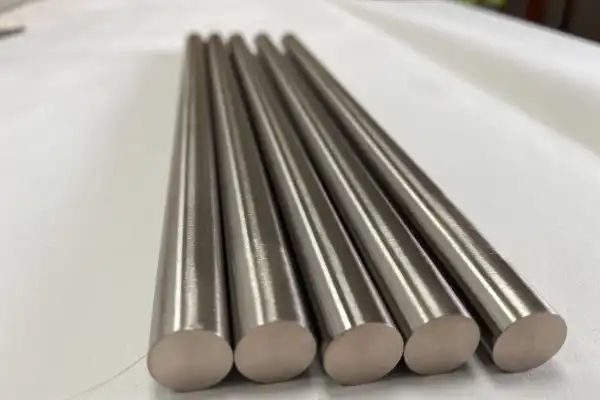
I have watched too many projects stall because the material specification was made without consulting the people who would actually cut the metal. Pure tungsten requires grinding or EDM for most operations. Turning pure tungsten on a lathe is possible with polycrystalline diamond tooling, very light depths of cut, and rigid setups, but the process is slow and tool wear is aggressive. Threading is best avoided entirely. If threads are essential, the design should probably be reconsidered for a tungsten alloy.
Tungsten alloy machines more like cast iron than like steel. The chips break short, the cutting forces are moderate, and standard carbide inserts work well at conservative speeds and feeds. Threading, grooving, and drilling operations that would destroy a pure tungsten blank are routine on WHA. This difference in machinability translates directly to part cost: a complex geometry that requires multiple setups and threaded features may cost three to five times more in pure tungsten than in an equivalent tungsten alloy, and the pure tungsten version may still carry a higher scrap rate.
The machinability divide also affects minimum order quantities and lead times. Shops that regularly process tungsten alloy can turn around parts in standard production schedules. Pure tungsten parts with demanding tolerances often require specialized grinding houses, longer queue times, and more generous delivery windows. If your procurement timeline is tight, this alone can push the decision toward an alloy grade. If your part design sits right at the boundary between what pure tungsten and tungsten alloy can handle, particularly with geometries that combine high-temperature requirements and threaded features, the material decision becomes a genuine engineering trade-off. Before finalizing your BOM, reach out at [email protected] with your drawing and we will review the geometry against both material options.
The right choice depends on what the part must do, not on which material has the higher numbers on a specification sheet. The table below summarizes the decision logic I use when advising clients on material selection.
| Application | Preferred Material | Reason |
|---|---|---|
| Vacuum furnace heating elements | Pure tungsten | Requires 3422°C capability; minimal machining needed |
| Aerospace counterweights | Tungsten alloy (W-Ni-Fe) | High density, machinable to tight tolerances |
| Medical radiation shielding | Tungsten alloy (W-Ni-Cu) | Non-magnetic, machinable into complex collimator shapes |
| Sputtering targets | Pure tungsten | Purity requirements and simple disc geometry |
| Balancing weights for motorsport | Tungsten alloy (W-Ni-Fe) | Requires threading and profiling |
| MRI components | Tungsten alloy (W-Ni-Cu) | Non-magnetic requirement is non-negotiable |
For applications not listed above, the deciding factors usually reduce to three questions. First, does the part require threading, undercuts, or complex profiles? If yes, lean toward tungsten alloy. Second, will the part see sustained temperatures above 1000°C in service? If yes, pure tungsten may be necessary because the binder phase in WHA can soften or oxidize at elevated temperatures. Third, is magnetic permeability a concern? If the part operates near sensitive magnetic fields, W-Ni-Cu is the only tungsten-based option.
Pure tungsten and tungsten alloy sit at different points on the cost spectrum, and the price difference is not simply about raw material. Pure tungsten powder and sintering processes are well established, but the post-sinter processing drives cost disproportionately. If the part can be used in near-net shape with only minimal grinding, pure tungsten is cost-competitive. If extensive machining is required, the labor and tooling cost swings the economics strongly in favor of tungsten alloy.
Tungsten alloy grades in the 90 to 95% W range with Ni-Fe binder are the most widely available and competitively priced. Non-magnetic W-Ni-Cu grades carry a moderate premium due to lower production volumes and the cost of nickel and copper powders. The highest-density grades, 97% W and above, are available but require tighter sintering control and have reduced machinability compared to 90 to 93% material, so the density gain must justify the processing trade-off.
From a sourcing standpoint, working with a supplier that produces both pure tungsten and tungsten alloy under one quality system simplifies incoming inspection and gives you an honest recommendation rather than one biased by what the supplier happens to stock. When a manufacturer has experience across the full tungsten material range, the conversation shifts from what is available to what makes sense for the part, and that question produces better outcomes.
The decision between pure tungsten and tungsten alloy is rarely about which material performs better in absolute terms. It is about which material performs well enough while staying within the limits of your manufacturing process, your budget, and your delivery schedule. When a design calls for complex geometry, threads, or production quantities that make grinding impractical, tungsten alloy is almost always the right answer. When extreme temperature performance or the highest possible density leaves no margin for compromise, pure tungsten holds its ground.
If your part geometry pushes the limits of what pure tungsten can tolerate in machining, or if your design includes features that would require multiple grinding setups, it is worth sending the drawing for a technical review before locking in the material specification. Share your drawing and quantity requirements with our engineering team at [email protected] or call +86 13995656368, and we will give you a practical assessment of which material path keeps your project on schedule and within budget.
It can, but only with the right tooling, very light cuts, and acceptance of slow material removal rates. Polycrystalline diamond tooling works for turning operations. Grinding is preferred for precision surfaces. If the part has more than basic geometry such as slots, holes, threads, or contours, the machining cost and risk of fracture usually make tungsten alloy the more practical choice.
It depends on the binder. W-Ni-Fe grades are slightly ferromagnetic because of the iron content. W-Ni-Cu grades are fully non-magnetic. If your application is in or near an MRI system, a sensitive sensor array, or any equipment where magnetic interference is a concern, specify the nickel-copper binder grade explicitly rather than assuming all tungsten alloys behave the same way.
Standard grades range from approximately 17.0 g/cc at 90% tungsten content to 18.8 g/cc at 97% tungsten content. Pure tungsten sits at 19.3 g/cc. For comparison, lead is 11.3 g/cc and steel is around 7.8 g/cc. Even a 90% tungsten alloy is roughly 50% denser than lead, which is why it works so well for compact counterweights and shielding applications where space is limited.
Tungsten alloy has good corrosion resistance in most industrial and atmospheric environments, with the nickel-iron or nickel-copper binder providing a protective effect. At elevated temperatures above approximately 500°C in air, oxidation accelerates, and above 1000°C the binder phase can begin to soften. For high-temperature oxidizing environments, pure tungsten or a protective coating may be necessary.
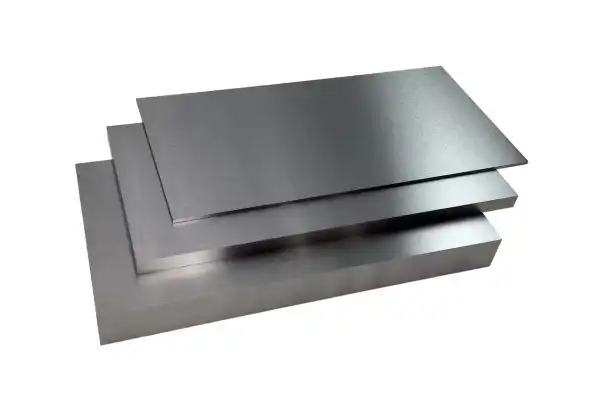
In our production experience, 90% W-Ni-Fe is the workhorse grade. It is widely available in rod, plate, and block form, competitively priced, and suitable for the majority of counterweight, ballast, and shielding applications. If your program calls for a specific grade but you are unsure about availability in the sizes you need, send your specifications to [email protected] and we will confirm current stock and lead times.
If you’re interested, check out these related articles:
Is Titanium Alloy Stronger Than Titanium
What Are The Properties Of Alsic Material
Exploring The Secrets Of Tungsten Sputtering Targets The Material Magician Of The Microscopic World
What Material Is Cuni44 Copper Nickel Alloy Plate
What Is Molybdenum Alloy