
Tungsten and molybdenum sit at the foundation of high-temperature industrial processing. These refractory metals handle conditions that would destroy conventional steels or aluminum alloys, which is why they appear in vacuum furnaces, aerospace thermal structures, and power electronics where failure is not an option. At Hubei Fotma Machinery Co., Ltd., we produce these materials in forms ranging from pure plates and wires to engineered composites that balance thermal expansion, conductivity, and mechanical strength for specific operating environments.
The practical value of tungsten comes from its 3422°C melting point and extreme hardness. Molybdenum, while slightly lower at 2620°C, offers better machinability and thermal conductivity that makes it preferable for heat sink applications. Neither material works in isolation for most modern applications, so we engineer alloys and composites that combine their strengths with copper, nickel, or iron binders depending on what the end use demands.
Pure tungsten and pure molybdenum each have limitations that become apparent in real operating conditions. Tungsten’s brittleness at room temperature makes machining difficult and creates fracture risks during thermal cycling. Molybdenum oxidizes rapidly above 500°C in air, restricting its use to vacuum or inert atmospheres unless protected. Alloys and composites solve these problems by introducing complementary properties.
Our Molybdenum-Copper (MoCu) Alloy demonstrates this principle. The powder-metallurgy process allows us to adjust the Mo/Cu ratio to match specific coefficient of thermal expansion (CTE) requirements, typically targeting 6-8 ppm/°C for semiconductor packaging applications. The copper phase provides thermal conductivity exceeding 160 W/m·K while the molybdenum skeleton maintains structural rigidity at temperatures that would soften pure copper. This combination makes MoCu the standard choice for high-power IGBT base plates and RF module heat spreaders.
Tungsten-Copper (W-Cu) alloys follow similar logic but target applications requiring higher density and arc resistance. The tungsten phase resists erosion from electrical arcing, which is why W-Cu appears in high-voltage switchgear contacts and resistance welding electrodes. We typically produce these at 70-90% tungsten content, adjusting the ratio based on whether the application prioritizes arc resistance or thermal management.
Electronic packaging engineers spend considerable time matching CTE between substrates, die attach materials, and heat sinks. A mismatch of even 2-3 ppm/°C creates thermal stress during power cycling that eventually causes solder joint fatigue or die cracking. Our CMC (Copper-Molybdenum-Copper) composite addresses this by sandwiching a molybdenum core between copper cladding layers, achieving CTE values between 6.5-8.5 ppm/°C depending on layer thickness ratios.
The table below compares our primary thermal management materials:
| Material Type | Key Properties | Primary Applications |
|---|---|---|
| Pure Molybdenum Plate | High melting point (2620°C), excellent high-temperature strength, low CTE, good machinability. | Vacuum furnace hot-zone parts, electronic heat sinks, X-ray targets, aerospace thermal structures. |
| Molybdenum-Copper (MoCu) Alloy | Tailored CTE, excellent heat dissipation, strong mechanical rigidity, good machinability, customizable Mo/Cu ratios. | High-power electronic packaging (heat sinks, spreaders), semiconductor base plates, MEMS. |
| Tungsten Copper (W-Cu) Alloy | High melting point, density, arc resistance (from W); high thermal/electrical conductivity (from Cu). | High-power heat sinks, optoelectronic substrates, high-voltage switchgear contacts, resistance welding electrodes. |
| CMC Copper-Molybdenum-Copper Composite | Precise CTE matching, excellent thermal/electrical conductivity, strong rigidity, high flatness. | High-power electronic packaging (IGBTs), RF/microwave modules, LED thermal bases, laser diode substrates. |
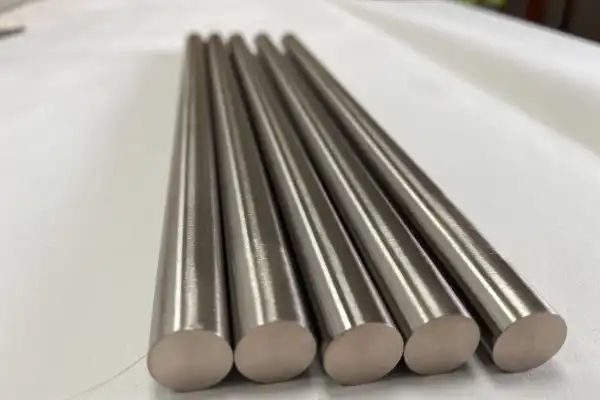
Flatness tolerance matters more than many specifications sheets suggest. A heat spreader with 0.05mm bow across a 50mm surface creates air gaps that increase thermal resistance by 20-30% compared to the theoretical contact value. We hold flatness to 0.02mm or better on CMC plates up to 100mm, verified by coordinate measuring machine inspection before shipping.
Thermal management represents only one application category. Wear resistance drives material selection for cutting tools, dies, and components exposed to abrasive environments. Cemented carbide, which combines tungsten carbide particles with a cobalt or nickel binder, achieves hardness values of 89-93 HRA that pure tool steels cannot approach.
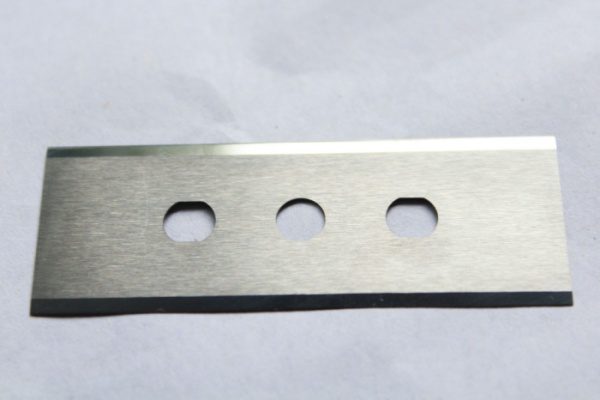
Our Carbide Moving Knife Blade illustrates the practical difference. In plastic recycling operations, conventional steel blades require replacement every 40-60 operating hours due to edge degradation from glass-filled polymers and contaminants. The tungsten carbide version maintains cutting performance for 400+ hours under the same conditions, reducing downtime and blade inventory costs despite the higher unit price. The economics work out favorably for any operation running more than single-shift production.
High-density tungsten alloys (WHA) serve different requirements. At 17-18.5 g/cm³ density, these materials provide radiation shielding equivalent to lead but with better mechanical properties and no toxicity concerns. Medical imaging equipment, industrial radiography enclosures, and aerospace counterweights all use WHA where the combination of density and machinability matters. We produce WHA with 85-97% tungsten content, using nickel-iron or nickel-copper binders depending on whether the application requires magnetic permeability or corrosion resistance.
Material specifications on paper mean nothing if production variability puts out-of-spec product into the supply chain. Our ISO-9000-1:2008 certification, maintained since 2004, establishes the framework, but the specific testing protocols determine whether quality control actually catches problems before shipment.
For high-density tungsten alloy counterweights destined for aerospace applications, we run eddy current testing on 100% of production to detect surface and near-surface discontinuities. Ultrasonic inspection follows for internal voids or inclusions that would affect density uniformity. On a recent batch of 500 counterweights for a flight control system application, this dual-inspection approach achieved 100% acceptance rate at the customer’s incoming inspection, which matters because rejected aerospace components require full documentation review and often cannot be reworked.
for Spraying)
Thermal spray wire presents different quality challenges. The Molybdenum Thermal Spray Wire we produce for automotive and industrial coating applications must maintain consistent diameter tolerance (typically ±0.02mm) and surface finish to feed properly through spray equipment. Wire that varies in diameter causes feed jams; surface contamination creates porosity in the deposited coating. We inspect wire continuously during drawing and perform lot-sample coating tests to verify spray characteristics before release.
Aerospace and medical applications share a common requirement: the material must perform exactly as specified because failure consequences are severe. The selection process differs from industrial applications where a 10% performance shortfall might mean reduced efficiency rather than catastrophic failure.
Titanium alloys dominate aerospace structural applications where the strength-to-weight ratio justifies the material cost premium over aluminum or steel. A Ti-6Al-4V component weighs roughly 40% less than the equivalent steel part at comparable strength, translating directly to fuel savings over aircraft service life. We supply titanium in plate, bar, and wire forms for machining into brackets, fasteners, and structural fittings.
Medical device applications add biocompatibility requirements. Commercially pure titanium (Grade 2 or Grade 4) and Ti-6Al-4V ELI (Extra Low Interstitials) meet FDA and ISO 10993 biocompatibility standards for permanent implants. The ELI designation indicates tighter control on oxygen, nitrogen, and carbon content that improves fatigue performance in the body’s corrosive environment. If your application involves implantable devices, confirming the specific titanium grade and interstitial limits early in design prevents qualification problems later.
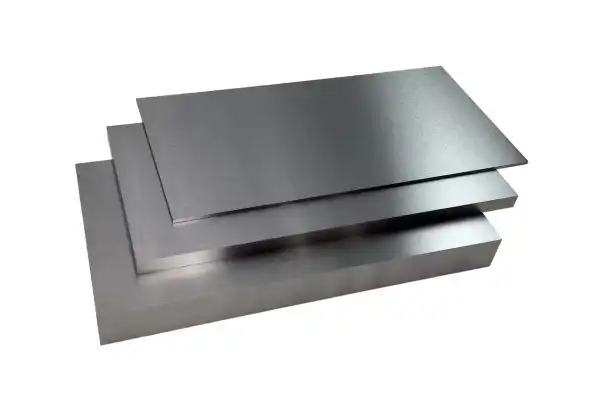
Nickel alloys fill the gap where titanium’s temperature limits become problematic. Inconel and Hastelloy grades maintain strength and corrosion resistance at temperatures that would degrade titanium’s mechanical properties. Chemical processing equipment, gas turbine hot sections, and nuclear applications commonly specify nickel alloys for components exposed to both high temperature and corrosive media.
Standard catalog materials solve most problems, but some applications require compositions or geometries that do not exist in standard production. Our materials research team, with over 30 years of accumulated experience in refractory metal processing, develops custom solutions when standard products fall short.
Recent custom projects have included modified MoCu compositions targeting specific CTE values for hybrid electronic assemblies, tungsten alloy formulations optimized for neutron shielding rather than gamma shielding, and complex-geometry molybdenum components machined from solid plate where casting would introduce unacceptable porosity. The development process typically involves material modeling, prototype fabrication, and property testing before committing to production tooling.
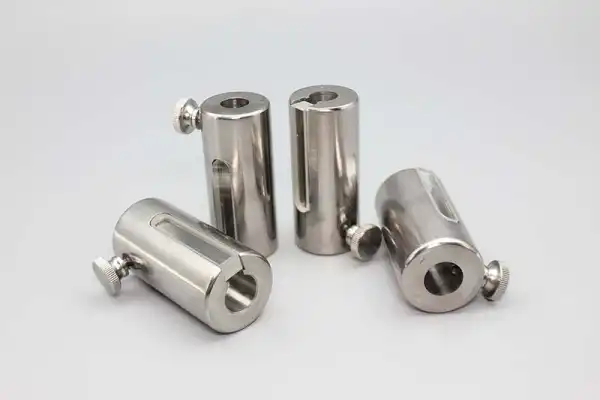
Custom work requires clear communication about performance requirements versus nice-to-have features. A request for “the highest possible thermal conductivity” without specifying CTE constraints, operating temperature range, or mechanical load requirements leaves too many variables open. The more precisely you can define the operating envelope and failure modes you need to avoid, the faster we can converge on a material solution that actually works.
Our core production focuses on tungsten-molybdenum products in pure and alloyed forms, including plates, rods, wires, and custom-machined components. The product line extends to cemented carbide cutting tools and wear parts, high-density tungsten alloys for shielding and counterweight applications, titanium alloys for aerospace and medical use, and nickel alloys for high-temperature corrosion-resistant applications. The common thread across all product lines is engineering materials for demanding environments where standard metals fail.
We routinely develop custom compositions and fabricate non-standard dimensions. The powder metallurgy processes used for our composite materials allow adjustment of constituent ratios to target specific property combinations. For machined components, we work from customer drawings to produce finished parts rather than requiring customers to source raw material and find separate machining vendors. Minimum order quantities for custom work depend on the complexity involved, so discussing your requirements early helps establish whether a custom development makes economic sense for your production volumes.
The customer base spans mechanical processing (cutting tools, wear parts, dies), electronics (thermal management substrates, heat sinks, contacts), aerospace (structural titanium, counterweights, thermal protection), medical devices (implant-grade titanium, radiation shielding), and energy (nuclear shielding, turbine components). The common factor across industries is applications where material performance directly affects product reliability or safety, justifying the cost premium over commodity metals.
Quality assurance starts with incoming raw material inspection and continues through in-process monitoring and final product testing. The specific test protocols depend on the material and application. Dimensional inspection uses coordinate measuring machines for precision components. Non-destructive testing (eddy current, ultrasonic, radiographic) verifies internal integrity for critical applications. Chemical analysis confirms composition. Mechanical testing (hardness, tensile, impact) validates properties against specifications. All test results are documented and traceable to specific production lots. For projects requiring formal material certification, we provide mill test reports and certificates of conformance matching customer documentation requirements.
To discuss specific material requirements or request quotations for your next project, contact us at [email protected] or call +86 13995656368 or +86 13907199894.
If you’re interested, check out these related articles:
What Is A Carbide Blade Good For
Unveiling The Wonders Of Titanium Foil A Comprehensive Guide
Analysis Of The Outstanding Performance Of Copper Molybdenum Copper Cmc Electronic Packaging And Heat Sink Materials
All You Need To Know About Copper Nickel Alloy Suppliers
Is Titanium Alloy Stronger Than Titanium