
Nickel alloys make modern jet engines possible. Without them, turbine blades would soften and fail within minutes of reaching operating temperature. These materials hold their shape and strength in conditions that would destroy conventional metals—temperatures exceeding 1,000°C, rotational forces measured in tons, and corrosive combustion gases attacking every exposed surface. The aerospace industry settled on nickel-based superalloys decades ago, and nothing has displaced them since.
The combustion section of a jet engine creates an environment that seems designed to destroy metal. Temperatures spike during takeoff, drop during cruise, and cycle repeatedly over a flight’s duration. Rotational speeds generate centrifugal forces that try to stretch turbine blades like taffy. Meanwhile, sulfur compounds and other combustion byproducts attack any surface they contact.
Nickel alloys survive this because of their atomic structure. The face-centered cubic crystal lattice of nickel remains stable at high temperatures, unlike iron-based alloys that undergo phase transformations and weaken. Adding chromium creates a protective oxide layer. Aluminum and titanium form strengthening precipitates called gamma prime phases that actually become more effective as temperatures rise—a counterintuitive property that makes these alloys uniquely suited for turbine applications.
Steel would creep and deform. Titanium alloys lose strength above 600°C. Only nickel-based superalloys maintain the combination of strength, oxidation resistance, and structural stability that turbine blades require.
Turbine blades occupy the most punishing location in any jet engine. They sit directly downstream of the combustion chamber, spinning at thousands of revolutions per minute while bathed in gases hot enough to melt many metals. The engineering challenge is straightforward to describe and extraordinarily difficult to solve: keep these blades functional for tens of thousands of flight hours.
Nickel superalloys address this through careful alloying. Chromium provides oxidation resistance. Cobalt raises the melting point and improves hot corrosion resistance. Molybdenum and tungsten strengthen the matrix. Aluminum and titanium create the gamma prime precipitates that give these alloys their high-temperature strength. The resulting compositions can contain ten or more elements, each serving a specific metallurgical purpose.
Single-crystal turbine blades represent the current state of the art. By eliminating grain boundaries—the weak points where creep failure typically initiates—these components achieve service lives that would have seemed impossible a generation ago.
Different sections of a turbine demand different alloy properties. The specific grades used reflect decades of operational experience and failure analysis.
Inconel 718 dominates applications where strength matters more than extreme temperature resistance. Turbine disks and shafts typically use this alloy because it machines relatively well and offers excellent fatigue properties. It works up to about 650°C before creep becomes problematic.
Waspaloy handles higher temperatures, making it suitable for turbine blades and vanes in less extreme sections. Its oxidation resistance holds up well in service.
René N5 and similar single-crystal alloys go into the hottest locations. These materials sacrifice weldability and repairability for maximum creep resistance. A single-crystal blade costs significantly more to produce, but the performance gains justify the expense in high-pressure turbine sections.
| Alloy Type | Key Properties | Typical Application |
|---|---|---|
| Inconel 718 | High strength, corrosion resistant | Turbine disks, shafts |
| Waspaloy | High-temp strength, oxidation resistant | Turbine blades, vanes |
| René N5 | Superior creep resistance, single-crystal | High-pressure turbine blades |
| CMSX-4 | High-temp strength, thermal stability | Advanced turbine blades |
| Hastelloy X | Good fabricability, oxidation resistance | Combustion liners |
Gas turbine engines subject their components to thermal conditions that test material limits. Inlet temperatures in modern high-bypass turbofans can exceed 1,500°C in the combustion zone. Turbine blades survive only because internal cooling passages and thermal barrier coatings reduce the metal temperature to levels the nickel alloys can tolerate—still above 1,000°C in many cases.
The oxidation resistance of nickel alloys comes from chromium and aluminum. These elements migrate to the surface and form protective oxide scales that slow further attack. The scales must adhere well and reform if damaged; spallation during thermal cycling would expose fresh metal to continued oxidation.
Hot corrosion presents a different challenge. Sulfur from fuel combines with sodium from ingested sea salt to form molten sulfates that dissolve protective oxides. Nickel alloys resist this through careful control of chromium content and the addition of elements like yttrium that improve oxide adhesion.
These protective mechanisms work together to give nickel alloy turbine blades service lives measured in tens of thousands of hours—remarkable durability given the operating conditions.
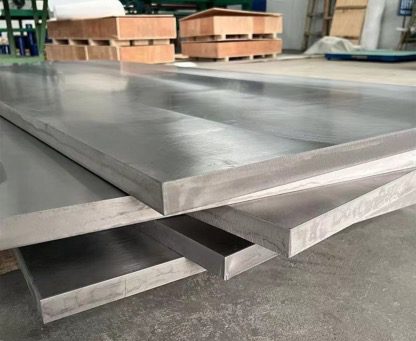
Producing turbine blades from nickel superalloys requires manufacturing processes as sophisticated as the materials themselves. The goal is achieving precise chemistry, controlled microstructure, and exact dimensions—all while working with alloys that resist conventional processing.
Vacuum induction melting eliminates atmospheric contamination that would degrade high-temperature properties. Investment casting creates the complex internal cooling passages that modern turbine blades require. Single-crystal growth involves carefully controlled solidification that eliminates grain boundaries entirely.
Hot isostatic pressing closes internal porosity that casting inevitably produces. Heat treatments develop the gamma prime precipitates that provide high-temperature strength. Surface treatments apply thermal barrier coatings and diffusion aluminide layers.
Every step requires documentation and verification. Aerospace certification demands traceability from raw materials through final inspection. A single turbine blade might carry documentation running to dozens of pages.
For further insights into material performance, explore our article: 《Comprehensive Applications Of Tungsten Copper Alloy In Aerospace And New Energy Vehicles》
Nickel superalloys resist machining with the same stubbornness they resist high-temperature deformation. Cutting tools wear rapidly. Heat builds up at the tool-workpiece interface. Work hardening makes each successive pass more difficult than the last.
Welding creates its own problems. Many nickel superalloys crack during solidification or during subsequent heat treatment. Repair welding of turbine blades requires specialized techniques and isn’t always possible—some single-crystal components cannot be welded at all without destroying their carefully developed microstructure.
Heat treatment windows can be narrow. The difference between optimal properties and degraded performance might be a few degrees of temperature or a few minutes of time. Process control must be precise and consistent.
These manufacturing challenges explain why aerospace nickel alloy components cost what they do. The materials are expensive, but the processing adds substantially more.
Material quality determines component performance. A turbine blade made from substandard alloy will fail, potentially catastrophically. Aerospace manufacturers cannot afford to compromise on material sourcing.
Reliable suppliers maintain complete traceability. They can document the origin of every element in an alloy, every step of processing, every test result. Their quality systems meet aerospace standards like AS9100. Their technical staff understand the applications and can advise on material selection.
Price matters, but not at the expense of quality. The cost of a turbine blade failure—in equipment damage, schedule disruption, and potential safety consequences—dwarfs any savings from cheaper materials. Experienced aerospace manufacturers understand this calculus.
Engine designers want higher operating temperatures. Every degree of increase improves thermodynamic efficiency, reducing fuel consumption and emissions. This pushes nickel alloys toward their limits and drives research into even more capable materials.
New alloy compositions explore different strengthening mechanisms. Some researchers are investigating alloys with higher refractory metal content for improved temperature capability. Others focus on environmental resistance, developing compositions that better resist the specific corrosive species found in modern fuels.
Additive manufacturing offers new possibilities for nickel alloy components. Laser powder bed fusion can create internal cooling geometries impossible to achieve through casting. The technology is maturing rapidly, with additively manufactured nickel alloy parts already flying in some applications.
Ceramic matrix composites may eventually replace nickel alloys in the hottest turbine sections, but that transition remains years away. For now and the foreseeable future, nickel superalloys remain the material of choice for aerospace turbine blades.
FOTMA provides non-ferrous metal materials and precision manufacturing solutions for aerospace applications. Our team brings over 30 years of material research experience to every project. Contact us to discuss your specific requirements: +86 13995656368, +86 13907199894, or email [email protected], [email protected].
Nickel superalloys maintain their strength at temperatures where other metals fail. Their face-centered cubic crystal structure remains stable up to near the melting point, and gamma prime precipitates actually strengthen as temperature increases. This combination of high-temperature strength, oxidation resistance, and microstructural stability makes them irreplaceable for turbine applications. No other material class offers this combination of properties.
Grain boundaries are the weak points in any polycrystalline metal. At high temperatures, creep deformation concentrates at these boundaries, eventually causing failure. Single-crystal blades eliminate grain boundaries entirely, dramatically improving creep resistance and fatigue life. The manufacturing cost is higher, but the performance improvement justifies the expense in high-pressure turbine sections where conditions are most severe.
Thermal barrier coatings are ceramic layers applied to blade surfaces that reduce heat transfer to the underlying metal. A coating just a few hundred microns thick can lower metal temperatures by 100-150°C. This temperature reduction significantly extends creep life and allows engines to operate at higher gas temperatures than the bare metal could tolerate. The coatings work together with internal cooling passages to keep blade temperatures within acceptable limits.