
RF and microwave systems keep pushing harder. Power densities climb, components shrink, and the heat has to go somewhere. I’ve watched traditional materials struggle to keep up with these demands, particularly when thermal cycling starts revealing the mismatch between heat sink and semiconductor. Silicon Aluminum Carbide composites handle this differently. The material brings together thermal conductivity and expansion characteristics that actually work with modern high-frequency components rather than against them.
The push toward 5G, satellite communications, and defense electronics has created thermal management problems that didn’t exist a decade ago. Power densities in RF modules have increased dramatically while physical footprints continue shrinking. Getting heat out of these systems efficiently determines whether they perform reliably or fail prematurely.
Pure copper conducts heat well. So does aluminum. But both expand at rates that create real problems when bonded to semiconductor materials. GaN and GaAs devices expand slowly compared to these metals. During thermal cycling, that mismatch generates stress at interfaces. Solder joints crack. Components delaminate. Systems fail.
Silicon Aluminum Carbide addresses this fundamental problem. The composite combines aluminum’s thermal conductivity with silicon carbide’s low expansion rate. Engineers can tune the expansion coefficient to match specific semiconductor materials, which eliminates much of the stress that destroys conventional assemblies. The material also weighs considerably less than copper, which matters in aerospace and portable applications where every gram counts.
| Material | Thermal Conductivity (W/mK) | CTE (ppm/°C) | Density (g/cm³) |
|---|---|---|---|
| AlSiC (typical) | 150-200 | 7-10 | 3.0-3.1 |
| Copper | 390 | 17 | 8.96 |
| Aluminum | 205 | 23 | 2.7 |
Silicon Aluminum Carbide belongs to a class called metal matrix composites. The manufacturing process embeds silicon carbide particles within an aluminum matrix, creating a material that behaves differently than either component alone.
Production typically involves pressureless infiltration or squeeze casting. Molten aluminum flows into a porous silicon carbide preform, filling the spaces between particles. The resulting bond between phases is metallurgical rather than mechanical, which gives the composite its structural integrity.
Silicon carbide contributes stiffness and low thermal expansion. The ceramic particles resist dimensional change when temperatures fluctuate. Aluminum provides the thermal pathway, conducting heat efficiently through the matrix. By adjusting the volume fraction of silicon carbide particles, manufacturers control the overall expansion coefficient. Higher silicon carbide content produces lower expansion rates.
This tunability is what makes Silicon Aluminum Carbide valuable for semiconductor packaging. A composite can be engineered to expand at nearly the same rate as GaN or GaAs, which means thermal cycling produces minimal stress at the interface. Components survive longer. Solder joints remain intact. Systems maintain performance over thousands of temperature cycles.
The low density of AlSiC, roughly one-third that of copper, also opens design possibilities. Aerospace applications benefit from reduced weight without sacrificing thermal performance. Portable systems become more practical when heat management doesn’t add excessive mass.
Silicon Aluminum Carbide works well in RF and microwave applications because it solves multiple problems simultaneously. The low density enables lightweight designs for aerospace and portable systems. High thermal conductivity moves heat away from active devices efficiently. The tunable expansion coefficient matches semiconductor materials closely, which prevents the thermal stress that causes failures in conventional assemblies. These properties combine to extend component life in harsh operating conditions.
Designing with Silicon Aluminum Carbide requires understanding both its capabilities and its constraints. The material machines differently than pure metals. Surface preparation affects thermal contact. Attachment methods influence long-term reliability.
Thermal analysis typically drives the initial design. Engineers identify where heat concentrates in an RF module and calculate the thermal resistance needed to maintain acceptable junction temperatures. Heat sink geometry follows from these calculations. Fin density, base thickness, and overall dimensions all affect how efficiently heat transfers from the device to the surrounding environment.
Attachment presents several options. Brazing creates strong metallurgical bonds but requires careful temperature control to avoid damaging nearby components. Adhesive bonding works at lower temperatures and accommodates some surface irregularity. Mechanical fastening allows for replacement but may introduce thermal resistance at the interface. Each method suits different applications and operating conditions.
Surface treatments extend the useful life of AlSiC components. Anodizing improves corrosion resistance. Nickel plating enhances solderability and provides a barrier against environmental degradation. These finishes also affect thermal emissivity, which matters in applications where radiative heat transfer contributes significantly to cooling.
Aerospace electronics rely heavily on Silicon Aluminum Carbide for radar systems and satellite communication components. The weight savings alone justify the material choice in many cases. Telecommunications infrastructure, particularly 5G base stations, uses AlSiC to handle the increased power densities that come with higher frequencies and more channels. Defense applications demand reliability under extreme conditions, making the thermal cycling resistance of AlSiC particularly valuable.
Thermal expansion mismatch causes failures in electronic assemblies. Understanding why helps explain the value of materials like Silicon Aluminum Carbide that can be engineered to match specific components.
Every material changes dimension when temperature changes. Metals generally expand more than ceramics or semiconductors. When two materials with different expansion rates are bonded together, temperature changes create stress at the interface. The material that wants to expand more is constrained by the material that doesn’t. The material that wants to expand less is stretched by its partner.
These stresses concentrate at attachment points. Solder joints experience the worst of it. During thermal cycling, the stress reverses direction repeatedly. Heating creates stress in one direction. Cooling reverses it. This cycling causes fatigue in the solder, eventually producing cracks that propagate until the joint fails completely.
The numbers illustrate the problem. Copper expands at 17 ppm/°C. GaN expands at roughly 5.6 ppm/°C. A 100°C temperature swing creates significant differential strain between these materials. Over thousands of cycles, that strain accumulates damage.
Silicon Aluminum Carbide can be formulated to expand at 7-10 ppm/°C, much closer to semiconductor values. The reduced mismatch means less stress per cycle. Less stress per cycle means slower damage accumulation. Slower damage accumulation means longer service life.
This isn’t just theoretical. Reliability testing confirms that AlSiC-based assemblies survive more thermal cycles than equivalent copper-based designs. The improvement can be substantial, often measured in multiples rather than percentages.
Hubei Fotma has produced advanced non-ferrous metal materials since 2004, building on more than three decades of material research. The facility in Wuhan houses production equipment capable of manufacturing High Silicon Aluminum Alloy Alsic to precise specifications.
ISO-9000-1:2008 certification reflects the quality management systems in place. Testing methods verify material properties and thermal performance before products ship. This combination of manufacturing capability and quality control supports applications where failure isn’t acceptable.
The product range extends beyond Silicon Aluminum Carbide to include tungsten-molybdenum products, tungsten-copper alloys, and cemented carbide. This breadth of materials expertise informs the approach to AlSiC development, drawing on understanding of how different material systems behave under demanding conditions.
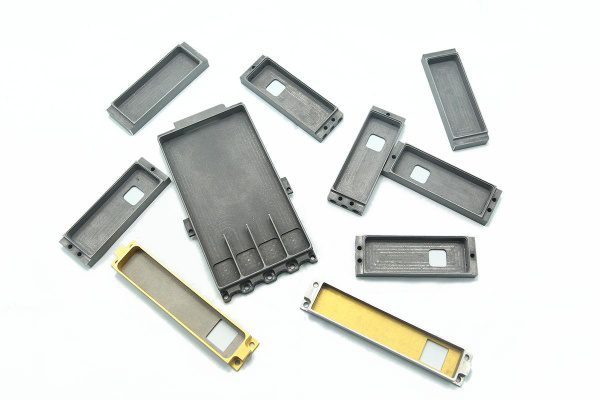
Custom heat sink designs address specific application requirements. Geometry, material formulation, surface treatment, and attachment features can all be tailored to match the thermal and mechanical needs of particular RF modules. The engineering team works with customers to develop solutions that integrate properly with existing system designs.
Quality assurance starts with controlled manufacturing processes and continues through comprehensive testing. ISO-9000-1:2008 certification establishes the framework for consistent production. Modern equipment maintains tight tolerances on critical dimensions. Testing verifies thermal conductivity, expansion coefficient, and mechanical properties. This systematic approach, supported by three decades of materials research experience, produces AlSiC components that meet demanding application requirements.
RF and microwave systems will continue demanding more from thermal management materials. Power levels keep increasing. Operating frequencies push higher. Physical dimensions shrink further. These trends intensify the thermal challenges that Silicon Aluminum Carbide addresses.
Research continues on several fronts. Improving thermal conductivity while maintaining low expansion remains a priority. Some formulations now achieve conductivity values approaching 200 W/mK while keeping expansion below 10 ppm/°C. Manufacturing techniques are evolving to produce more complex geometries cost-effectively. Near-net-shape processing reduces machining requirements and material waste.
Phased array antennas represent a growing application area. These systems pack many active elements into compact arrays, creating concentrated heat loads that require efficient removal. Silicon Aluminum Carbide’s combination of thermal performance and expansion matching suits this application well.
5G infrastructure deployment drives demand for materials that can handle higher power densities in base station amplifiers. The frequency bands used for 5G require different amplifier technologies than previous generations, often with higher power dissipation per unit area. AlSiC provides the thermal management capability these systems need.
Satellite communications continue expanding, with new constellations requiring thousands of spacecraft. Weight constraints in space applications favor lightweight thermal solutions. Silicon Aluminum Carbide offers the thermal performance of heavier materials at a fraction of the mass.
Hubei Fotma provides Silicon Aluminum Carbide heat sinks engineered for RF and microwave applications. The manufacturing capability, materials expertise, and quality systems support demanding projects where thermal performance directly affects system reliability.
Technical discussions can address specific application requirements, material options, and design approaches. The engineering team has experience with a range of RF and microwave packaging challenges and can contribute to solution development.
Contact information: [email protected], [email protected], +86 13995656368, +86 13907199894.
The primary reliability advantage comes from reduced thermal stress during temperature cycling. When a Silicon Aluminum Carbide heat sink expands at nearly the same rate as the semiconductor it supports, solder joints and interfaces experience less strain per cycle. This translates directly to longer service life. The high thermal conductivity also keeps junction temperatures lower, which reduces thermally-activated degradation mechanisms in the semiconductor devices themselves.
Silicon Aluminum Carbide weighs roughly one-third as much as copper while providing comparable thermal management capability. This density advantage allows designers to reduce system weight without compromising thermal performance. In some cases, the weight savings enable smaller enclosures or additional functionality within the same weight budget. Aerospace and portable applications benefit most directly from this characteristic.
Custom designs are a core capability. The manufacturing facility handles both standard configurations and application-specific geometries. Engineering support helps translate thermal requirements into practical heat sink designs that integrate with existing module architectures. Material formulation, dimensions, surface treatments, and attachment features can all be specified to match particular application needs.