
Tungsten has always been a difficult material to work with. Its melting point sits at 3422°C, higher than any other metal, and that extreme heat resistance comes packaged with brittleness that makes conventional machining a constant battle against cracking. Additive manufacturing is changing this equation. The ability to build tungsten components layer by layer, controlling thermal input precisely, opens design possibilities that were simply not available five years ago. Engineers working on radiation shielding, fusion reactor components, and aerospace thermal management now have a manufacturing path that does not require them to compromise on geometry to accommodate the material’s limitations.
The same properties that make tungsten valuable create the processing difficulties. That 3422°C melting point demands enormous energy input from whatever heat source is doing the melting. When you concentrate that much energy into a small melt pool and then let it cool rapidly, thermal gradients become severe. The material contracts unevenly, stresses accumulate, and cracks form.
| Property | Tungsten | Molybdenum | Copper |
|---|---|---|---|
| Melting Point (°C) | 3422 | 2623 | 1085 |
| Density (g/cm³) | 19.3 | 10.2 | 8.96 |
| Hardness (HV) | ~350 | ~150 | ~40 |
| Thermal Conductivity (W/m·K) | 173 | 138 | 401 |
| CTE (10⁻⁶/K) | 4.5 | 4.8 | 17 |
Tungsten’s ductile-to-brittle transition temperature sits well above room temperature, which means printed parts are brittle during and after cooling. Micro-cracks propagate easily through the layer interfaces. Porosity, those small voids that form when the melt pool does not fully consolidate, weakens the final part and creates stress concentrators. Oxygen contamination is another persistent problem. Tungsten oxidizes readily at elevated temperatures, and oxide inclusions degrade mechanical properties. Processing must happen in vacuum or high-purity inert atmospheres, adding cost and complexity.
The powder itself matters enormously. Particle size distribution affects how evenly the powder bed packs. Morphology determines flowability. Oxygen content in the powder carries directly into the printed part. Getting all of these characteristics right is not optional; it is the foundation that everything else builds on.
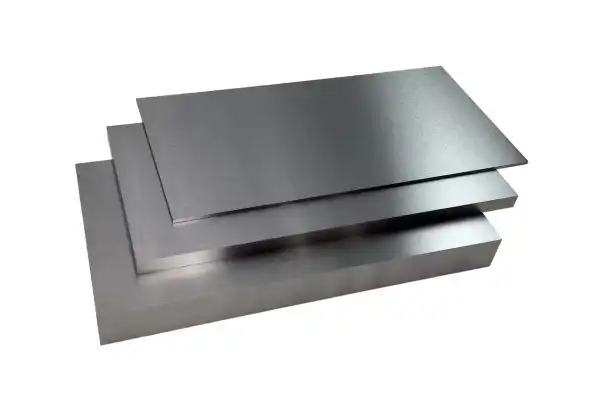
Electron Beam Melting and Laser Powder Bed Fusion represent the two dominant approaches for tungsten additive manufacturing, and they solve the thermal management problem in fundamentally different ways.
EBM operates in vacuum, which eliminates oxidation concerns entirely. The electron beam preheats the entire powder bed before selective melting begins, raising the working temperature high enough to reduce thermal gradients during solidification. This preheating is the key advantage. Parts come out with lower residual stress and fewer cracks than LPBF typically achieves with tungsten. Densities above 98% are achievable with optimized parameters.
LPBF uses a laser in an inert gas atmosphere, usually argon. The laser spot is smaller than an electron beam, which enables finer feature resolution and better surface finish. The tradeoff is that the localized heating and rapid cooling create steeper thermal gradients. Managing crack formation requires careful parameter development: laser power, scan speed, hatch spacing, layer thickness, and scan strategy all interact. Getting LPBF to work reliably with tungsten took years of research, and even now, achieving densities above 98% requires tight control over every variable.
| AM Technology | Energy Source | Atmosphere | Key Advantage for Tungsten | Typical Density |
|---|---|---|---|---|
| Electron Beam Melting (EBM) | Electron Beam | Vacuum | Reduced thermal stress, high density | >98% |
| Laser Powder Bed Fusion (LPBF) | Laser | Inert Gas | High resolution, fine features | 95-99% |
| Binder Jetting | Binder | Air/Inert | Low residual stress, high throughput | Post-sintering dependent |
| Directed Energy Deposition (DED) | Laser/E-beam | Inert Gas | Repair/cladding, large parts | 90-98% |
Binder Jetting takes a completely different approach. A liquid binder selectively joins powder particles at room temperature, building up a green part that then goes into a high-temperature sintering furnace. No melting occurs during printing, which eliminates thermal stress during that stage. The challenge shifts to the sintering step, where achieving full density without excessive shrinkage or distortion requires careful furnace profile development. This process shows promise for higher throughput and lower machine costs, though the final density depends heavily on sintering optimization.
Directed Energy Deposition works well for adding material to existing components, making it valuable for repair applications or adding tungsten cladding to parts made from other materials. Build rates are higher than powder bed processes, but surface finish and feature resolution are coarser.
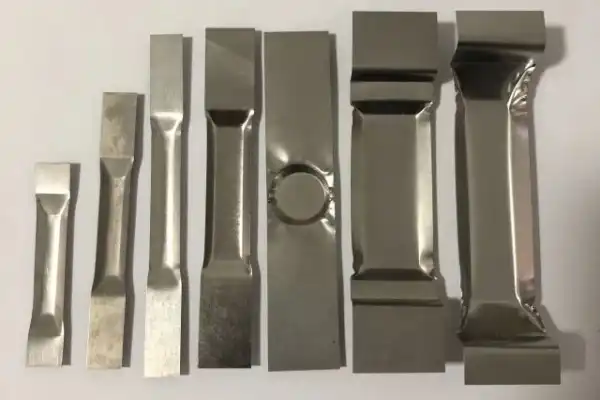
The relationship between powder characteristics and final part quality is direct and measurable. I have seen projects stall for months because the powder specification was not tight enough, and I have seen the same geometry print successfully once the powder was right.
One LPBF project targeting radiation shielding components illustrates this clearly. Initial builds using commercially available tungsten powder produced parts with persistent porosity, densities stuck around 95%, and micro-cracks visible in cross-sections. The team adjusted laser parameters extensively without solving the problem. The breakthrough came from the powder side. Reducing oxygen content below 500 ppm and narrowing the particle size distribution eliminated the variability that was causing inconsistent melt pool behavior. Density jumped to above 98.5%, and the micro-cracking that had been disqualifying parts for the application essentially disappeared. That 3.5% density improvement was the difference between parts that met the radiation attenuation specification and parts that did not.
Powder morphology affects flowability, which determines how evenly each layer spreads. Irregular particles create uneven packing, which leads to localized porosity. Spherical particles with consistent size flow predictably and pack uniformly. For tungsten, achieving good sphericity typically requires plasma atomization or similar high-energy processes, which adds cost but pays off in part quality.
Tungsten-molybdenum alloys are receiving attention because alloying can modify thermal expansion behavior and potentially improve ductility. The printability improvements are real, though the tradeoffs in other properties need evaluation for each application. If your situation involves pushing density limits or working with complex geometries, discussing powder specifications before committing to a build campaign is worth the time.
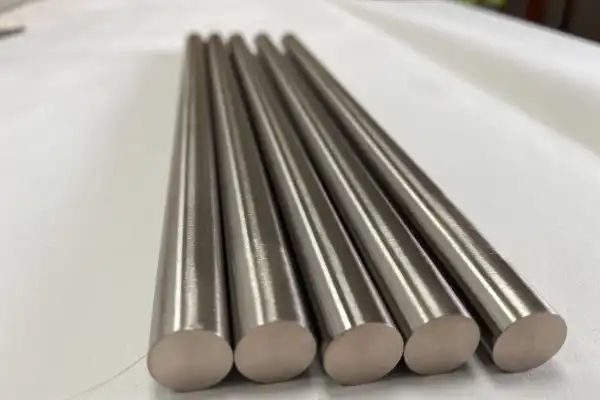
The applications driving tungsten additive manufacturing adoption share common requirements: extreme environments, complex geometries, and situations where tungsten’s density or radiation attenuation cannot be substituted.
Medical imaging equipment uses tungsten collimators to shape X-ray beams precisely. Traditional collimators are machined from solid tungsten, which limits the achievable geometry and wastes material. Additive manufacturing enables collimator designs with internal channels and optimized aperture patterns that improve beam quality while reducing component weight. X-ray tube anodes benefit similarly, with printed geometries that improve heat dissipation.
Aerospace thermal management presents another strong use case. Rocket nozzle components and heat sinks operating at extreme temperatures can incorporate internal cooling channels that would be impossible to machine. The ability to place material exactly where thermal or structural analysis says it should be, rather than where machining constraints allow, changes what designs are feasible.
Fusion reactor development is pushing tungsten additive manufacturing forward. Plasma-facing components in tokamak designs must withstand intense heat flux and neutron bombardment. Tungsten’s combination of high melting point, thermal conductivity, and low sputtering yield makes it the leading candidate material. Additive manufacturing allows these components to incorporate cooling channels and graded structures that improve thermal management and extend service life.
Defense applications include kinetic energy penetrators, where tungsten’s density provides the momentum needed for armor penetration, and specialized shielding components. The ability to produce these parts without the tooling lead times of traditional manufacturing offers operational advantages.
Process control is advancing faster than most people outside the field realize. In-situ monitoring systems that track melt pool characteristics in real time are moving from research labs into production machines. These systems detect anomalies as they happen, enabling parameter adjustments during the build rather than discovering problems during post-build inspection. For a material as sensitive to processing conditions as tungsten, this capability matters.
Alloy development is expanding beyond pure tungsten and simple binary systems. Compositions targeting specific property combinations, such as improved ductility without sacrificing high-temperature strength, or optimized thermal conductivity for heat sink applications, are in active development. The goal is matching the alloy to the application rather than forcing applications to work within pure tungsten’s limitations.
Cost reduction will come from multiple directions. Machine throughput is improving as build strategies become more sophisticated. Powder production efficiency is increasing as demand grows and processes mature. Post-processing, particularly the heat treatments and surface finishing that printed parts often require, is becoming more streamlined. These incremental improvements compound, and the cost trajectory is clearly downward.
The broader trend is tungsten additive manufacturing becoming a standard option rather than a research curiosity. For applications where the material properties justify the cost, the question is shifting from whether additive manufacturing can produce acceptable parts to which additive process and parameter set produces the best parts for a given geometry and specification.
What are the main challenges in 3D printing pure tungsten?
The primary obstacles are thermal stress management and brittleness. Tungsten’s 3422°C melting point requires intense energy input, and the rapid cooling that follows creates steep thermal gradients. These gradients generate stresses that exceed the material’s fracture toughness, resulting in cracks. Porosity control requires precise melt pool behavior, which depends on powder quality and parameter optimization. Oxygen contamination during processing degrades mechanical properties, necessitating vacuum or high-purity inert atmospheres.
Which additive manufacturing processes are suitable for tungsten?
Electron Beam Melting works well because the vacuum environment prevents oxidation and powder bed preheating reduces thermal gradients. Laser Powder Bed Fusion achieves higher resolution but requires more careful parameter development to manage cracking. Binder Jetting avoids thermal stress during printing entirely, shifting the densification challenge to a separate sintering step. The right choice depends on the specific geometry, density requirements, and production volume.
What are the industrial applications of 3D printed tungsten components?
Medical radiation shielding, including X-ray collimators and imaging equipment components, represents a significant application area. Aerospace uses include rocket nozzle components, heat sinks, and counterweights where tungsten’s density and thermal properties are required. Fusion reactor development relies on tungsten for plasma-facing components. Defense applications include kinetic energy penetrators and specialized shielding.
Is 3D printed tungsten as strong as traditionally manufactured tungsten?
The gap is closing. EBM-printed tungsten routinely achieves densities above 98%, and optimized LPBF processes reach similar levels. Mechanical properties depend heavily on density, microstructure, and residual stress state. For applications where near-full density is achieved and appropriate heat treatments are applied, printed tungsten performs comparably to wrought material. The advantage of additive manufacturing is accessing geometries that wrought processing cannot produce.
Can tungsten alloys also be 3D printed, or only pure tungsten?
Tungsten alloys are printable and sometimes easier to process than pure tungsten. Tungsten-molybdenum alloys can offer improved ductility. Tungsten-copper composites combine tungsten’s density with copper’s thermal conductivity for heat sink applications. The alloy composition affects melting behavior, thermal expansion, and solidification characteristics, so parameter development is required for each new composition. For specific material requirements, Hubei Fotma Machinery Co., Ltd. can be reached at [email protected] or +86 13995656368.
If you’re interested, check out these related articles:
Custom Molybdenum Parts Processing Molybdenum Screw
What Is The Most Commonly Used Titanium Alloy
What Is Tungsten Copper Used For