
Tungsten counterweights solve a specific engineering problem: fitting enough mass into a tight space to balance a rotating or moving assembly. The material’s density, ranging from 17.0 to 18.5 g/cm³ depending on alloy composition, means a tungsten counterweight can be half the size of a steel one at the same mass. That dimensional advantage matters in aerospace actuators, medical imaging gantries, and high-speed rotating machinery where every cubic centimeter is contested.
The calculation itself is straightforward. If a system needs 500 grams of additional mass and the available cavity measures 27.8 cm³, the minimum required density is 18.0 g/cm³. Steel at 7.8 g/cm³ would need 64 cm³ for the same mass, more than double the volume. Lead at 11.3 g/cm³ would need 44 cm³, still 58% larger than the tungsten solution. These numbers drive material selection before any detailed design work begins.
Pure tungsten is brittle and difficult to machine. Tungsten heavy alloys, typically 85–97% tungsten with nickel-iron or nickel-copper binders, retain most of the density while gaining ductility and machinability. A 90% tungsten alloy with nickel-iron binder machines cleanly on standard CNC equipment and holds tolerances under ±0.05 mm without special tooling.
The density advantage over common alternatives is substantial:
| Material | Density (g/cm³) | Relative Density | Machinability | Cost Factor |
|---|---|---|---|---|
| Tungsten | 17.0–18.5 | 1.0 | Good | High |
| Lead | 11.3 | 0.65 | Excellent | Low |
| Steel | 7.8 | 0.45 | Excellent | Low |
| Brass | 8.5 | 0.49 | Excellent | Medium |
Lead is cheap and easy to cast, but its toxicity creates handling and disposal complications. Steel is inexpensive and readily available, but its lower density forces larger counterweight volumes. Brass falls between steel and lead in density, offering no particular advantage for mass-critical applications. Tungsten heavy alloys cost more per kilogram, but the reduced volume often simplifies the surrounding structure and shrinks the overall assembly envelope.
A counterweight’s job is to shift the center of mass of an assembly. The required mass depends on the imbalance being corrected, and the required placement depends on the moment arm from the rotation axis. A 100-gram counterweight mounted 50 mm from the axis produces the same balancing moment as a 50-gram counterweight at 100 mm. When space constraints fix the mounting location, the counterweight mass is determined by geometry.
Moment of inertia matters for dynamic applications. A counterweight concentrated near the rotation axis adds less rotational inertia than the same mass distributed farther out. In high-speed rotating assemblies, minimizing moment of inertia reduces bearing loads and allows faster acceleration. Tungsten’s density enables compact counterweights that stay close to the axis, keeping moment of inertia low while delivering the required balancing mass.
I worked on a rotor balancing project where the original steel counterweights extended 35 mm from the rotation axis. Switching to tungsten heavy alloy at 18.0 g/cm³ allowed us to achieve the same balancing mass in a package that extended only 22 mm. The reduced moment of inertia dropped bearing loads by 15% and extended the maintenance interval from 8,000 hours to 12,000 hours.
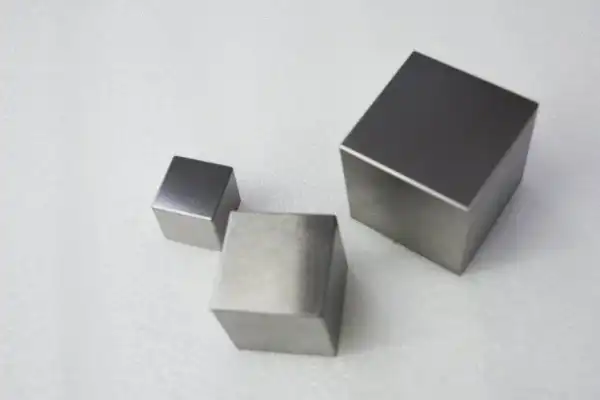
The density calculation starts with two fixed parameters: the required mass and the maximum allowable volume. Dividing mass by volume gives the minimum density the material must provide.
| Parameter | Formula | Units | Description |
|---|---|---|---|
| Density | ρ = m / V | g/cm³ | Mass per unit volume |
| Mass | m = ρ * V | g | Total weight of the object |
| Volume | V = m / ρ | cm³ | Space occupied by the object |
If the calculation yields a required density above 18.5 g/cm³, the design has a problem. No commercially available tungsten alloy exceeds that density. The options are to increase the available volume, reduce the required mass by repositioning the counterweight farther from the axis, or accept that the balancing requirement cannot be met within the geometric constraints.
When the required density falls between 17.0 and 18.5 g/cm³, alloy selection becomes the variable. Higher tungsten content increases density but reduces ductility. A 97% tungsten alloy at 18.5 g/cm³ machines adequately for simple geometries but may chip during complex profiling. An 85% tungsten alloy at 17.0 g/cm³ machines like brass and tolerates intricate features. The right choice depends on both the density requirement and the geometric complexity.
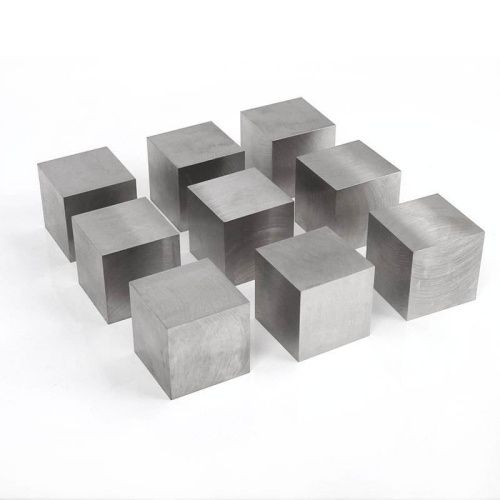
Tungsten heavy alloys are produced through powder metallurgy. Fine tungsten powder is blended with binder metals, pressed into a compact, and sintered at temperatures between 1,400°C and 1,500°C. The sintering process bonds the particles into a solid mass with density approaching theoretical maximum. Post-sintering machining brings the part to final dimensions.
Dimensional tolerances of ±0.025 mm are achievable with careful process control. The sintering step causes predictable shrinkage, typically 15–20% linear, which must be accounted for in the pressed compact dimensions. Coordinate measuring machines verify final dimensions against CAD models. Ultrasonic inspection detects internal voids or inclusions that could affect mass distribution.
Surface finish matters for counterweights that interface with precision assemblies. Ground surfaces achieve Ra 0.8 μm or better. Polished surfaces reach Ra 0.2 μm when required for sealing surfaces or aesthetic applications. Plating with nickel or gold provides corrosion protection and improves appearance without significantly affecting mass.
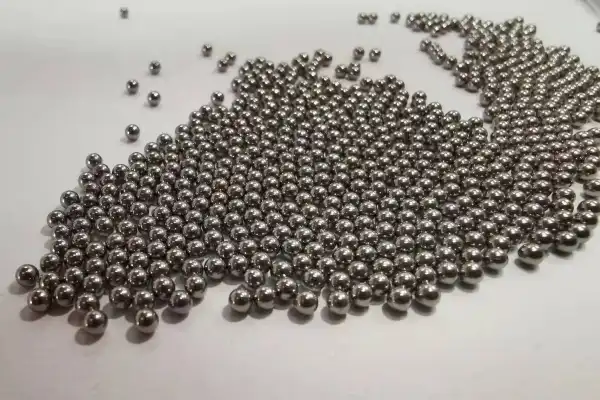
Aerospace applications demand the highest density-to-volume ratios. Control surface actuators, helicopter rotor hubs, and satellite momentum wheels all benefit from compact tungsten counterweights. The weight savings from smaller counterweight housings often offsets the higher material cost.
Medical imaging equipment uses tungsten counterweights in CT scanner gantries and X-ray tube assemblies. The same density that makes tungsten effective for counterweighting also provides radiation shielding, allowing dual-function components that balance the gantry while blocking stray X-rays.
Automotive crankshaft balancing represents a high-volume application. Performance engines with lightweight pistons and connecting rods require precise counterweighting to minimize vibration. Tungsten inserts pressed into steel counterweight bobs concentrate mass where needed without increasing the overall crankshaft diameter.
If your application involves tight geometric constraints or requires combining counterweighting with radiation shielding, a conversation about tungsten alloy options is worth having before finalizing the design.
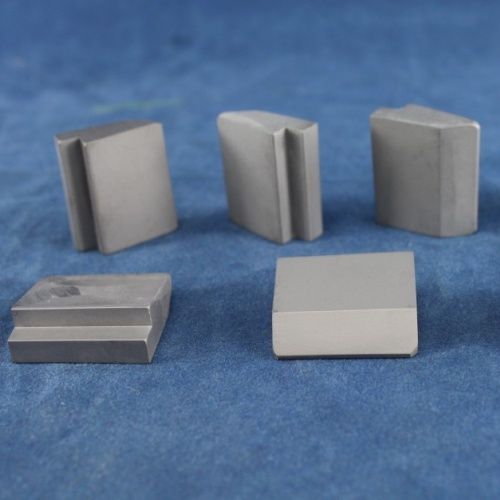
Tungsten’s density of 17.0–18.5 g/cm³ exceeds lead by 50% and steel by 130%. A tungsten counterweight occupies roughly half the volume of a steel counterweight at the same mass. This size reduction matters in applications where the counterweight must fit within a constrained envelope, such as inside a rotating hub or adjacent to other components. Tungsten also avoids the toxicity concerns associated with lead, simplifying handling and disposal.
The selection process starts with the required density and the geometric complexity. Higher tungsten content (95–97%) provides higher density but reduced ductility, suitable for simple shapes. Lower tungsten content (85–90%) improves machinability for complex profiles at the cost of some density. Thermal expansion coefficient also factors in when the counterweight must maintain tight clearances across a temperature range.
Standard machining achieves ±0.05 mm on critical dimensions. Precision grinding reaches ±0.025 mm. Mass tolerances of ±0.5% are typical, with ±0.1% achievable through iterative machining and weighing. These tolerances meet the requirements of most aerospace and medical applications without special processing.
Powder metallurgy allows near-net-shape production of moderately complex geometries. Features like internal cavities, undercuts, and thin walls require careful tooling design but are achievable. Post-sintering machining adds details that cannot be pressed directly. Multi-piece assemblies with brazed or mechanically fastened joints extend the range of possible geometries.
The cost justification depends on how much the density advantage simplifies the surrounding design. When a tungsten counterweight eliminates the need for a larger housing, longer shaft, or additional bearings, the system-level savings often exceed the material cost premium. In applications where space is not constrained, steel or lead may be more economical. For projects where geometric constraints drive the design, discussing tungsten options with a materials specialist can clarify whether the investment makes sense.
Hubei Fotma Machinery Co., Ltd. produces tungsten heavy alloys in grades from 17.0 to 18.5 g/cm³ and machines counterweights to customer specifications. To discuss material selection or request a quote for custom counterweights, contact the engineering team at +86 13995656368 or +86 13907199894, or email [email protected].
If you’re interested, check out these related articles:
Custom Molybdenum Parts Processing Molybdenum Screw
What Do Copper And Nickel Make
Panoramic Analysis Of Chinas Molybdenum Industry In 2025 Market Status And Downstream Application Discussion
Manufacturing Process Of High Quality Molybdenum Plate Products