
Getting metal density to weight conversions right is one of those things that separates a smooth OEM project from one that bleeds money at every stage. When you know exactly how much a part will weigh before cutting metal, you can order the right amount of raw material, quote shipping accurately, and catch design problems before they become expensive production problems. The relationship between density, mass, and volume is straightforward in theory, but applying it to real manufacturing situations requires attention to details that textbooks tend to skip.
Density is mass per unit volume. For metals, we typically express it in grams per cubic centimeter or kilograms per cubic meter. The formula itself is simple: multiply the volume of your part by the material’s density, and you get the theoretical weight. The problem is that the density value you plug into that formula matters enormously, and published values are nominal figures for pure or standard compositions.
Actual densities vary. A 6061-T6 aluminum extrusion and a cast A356 aluminum part will not have identical densities, even though both are “aluminum.” Alloy composition shifts the number. Manufacturing process affects it too, since castings can contain microporosity that reduces effective density by a few percent. Temperature during measurement and during service also plays a role, though for most room-temperature applications this effect is small enough to ignore.
For OEM work, I treat reference table values as a starting point. When weight tolerance is tight, or when the material is expensive, verifying density on incoming stock is worth the effort. A simple displacement test or a calibrated sample weighing can catch discrepancies before they propagate through your cost estimates.
| Metal Type | Typical Density (g/cm³) | Density (kg/m³) | Density (lb/in³) |
|---|---|---|---|
| Aluminum | 2.70 | 2700 | 0.0975 |
| Titanium | 4.50 | 4500 | 0.1625 |
| Steel (Carbon) | 7.85 | 7850 | 0.2835 |
| Copper | 8.96 | 8960 | 0.3237 |
| Tungsten | 19.30 | 19300 | 0.6970 |
| Molybdenum | 10.20 | 10200 | 0.3685 |

Simple shapes are easy. A cylindrical rod, a rectangular plate, a tube with uniform wall thickness: you can calculate the volume with basic geometry formulas and multiply by density. The challenge comes with complex machined parts, and this is where CAD software earns its keep.
Modern CAD systems calculate volume directly from the 3D model, accounting for every pocket, bore, fillet, and chamfer. If your model is accurate, the volume output is accurate. The weight calculation then becomes a matter of assigning the correct material density to that model. Most CAD packages include material libraries, but I always double-check that the library value matches the specific alloy I am actually using.
Consider a machined tungsten alloy component with a calculated volume of 50 cm³. Using a density of 18.5 g/cm³ for that particular alloy grade, the theoretical weight comes to 925 grams. That number drives material ordering, machining time estimates, and shipping quotes. If the density value is off by even 2%, you are looking at nearly 20 grams of error on a single part. Scale that across a production run of thousands, and the cost impact becomes significant.
Manufacturing process matters here too. Forged parts tend to have higher and more uniform density than castings because the forging process closes internal voids. Cast parts may have porosity that reduces actual density below the nominal value. Machined parts start from billet stock, so the final weight depends on how much material you remove. For cost estimation, you need to account for both the finished part weight and the chip weight, since you are paying for all of it.
Specific gravity is the ratio of a material’s density to the density of water. Since water has a density of 1 g/cm³ at standard conditions, specific gravity is numerically equal to density expressed in g/cm³, but it is dimensionless. This makes it useful for quick comparisons between materials without worrying about unit conversions.
When evaluating material options for a weight-sensitive application, specific gravity lets you compare directly. Titanium at 4.5 versus steel at 7.85 tells you immediately that a titanium part of the same volume will weigh about 57% as much as the steel version. For aerospace or portable equipment where every gram counts, this comparison drives material selection decisions early in the design process.
Specific gravity also comes up in quality control. A quick density check on incoming material, compared against the expected specific gravity for that alloy, can flag composition problems or contamination before the material goes into production.
Not every application calls for minimizing weight. Counterweights, radiation shielding, vibration damping, and ballast all require maximum mass in minimum volume. This is where tungsten alloys and similar high-density materials become the only practical choice.
Tungsten’s density of 19.3 g/cm³ is more than twice that of steel and more than seven times that of aluminum. A tungsten counterweight can be a fraction of the size of a steel counterweight with the same mass. In applications where space is constrained, such as inside rotating machinery or compact medical devices, this density advantage is not optional.
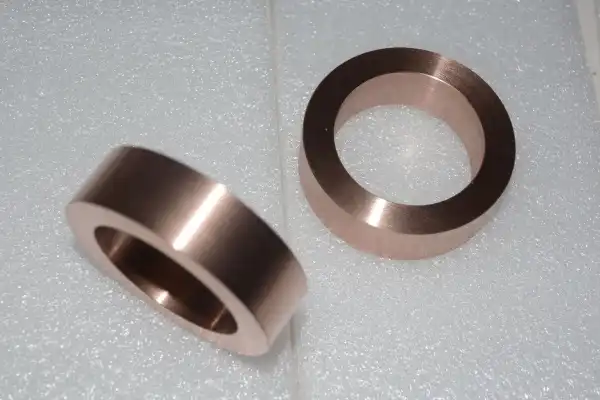
Molybdenum-copper alloys occupy a different niche. They combine molybdenum’s low coefficient of thermal expansion with copper’s high thermal conductivity. For heat sinks and spreaders in high-power electronics, this combination manages thermal stress while moving heat efficiently. The density to weight calculation for these parts affects both the thermal design and the mechanical mounting requirements.
Metals expand when heated. As volume increases, density decreases. For most OEM applications at or near room temperature, this effect is small enough to ignore. But for parts that operate at elevated temperatures, or for precision applications where even small dimensional changes matter, thermal expansion needs to be part of the calculation.
The coefficient of thermal expansion tells you how much a material’s dimensions change per degree of temperature change. Multiplying this out to volume change and recalculating density gives you the effective density at operating temperature. For a tungsten part operating at several hundred degrees Celsius, the density drop is measurable but typically under 1%. For aluminum at the same temperature increase, the effect is larger because aluminum has a higher expansion coefficient.
In practice, I factor this in when the application involves significant temperature swings or when the part must meet tight weight specifications at operating temperature rather than room temperature.
The most frequent error I see is using a generic density value when a specific alloy value is available. “Steel” covers a range from about 7.75 to 8.05 g/cm³ depending on composition. Using 7.85 for everything introduces error that accumulates across a project.
The second common mistake is ignoring manufacturing process effects. A cast part with 2% porosity has an effective density 2% lower than the solid material. If you quote based on solid density and then weigh the actual castings, you will find they are lighter than expected. This sounds like a good thing until you realize the porosity also affects mechanical properties and may cause rejection.
Unit conversion errors still happen, especially when mixing metric and imperial systems. Density in g/cm³ multiplied by volume in cubic inches gives nonsense. Keeping units consistent throughout the calculation, or using software that handles conversions automatically, prevents this class of error.
Finally, overlooking material removal in machining leads to incorrect raw material orders. If your finished part weighs 500 grams but you machine it from a 2 kg billet, you need to order and pay for 2 kg of material per part, not 500 grams.
Temperature affects metal density through thermal expansion. As a metal heats up, its volume increases while its mass stays constant, so density decreases. For most OEM work at room temperature, this effect is negligible. For high-temperature applications or precision work, you can adjust the calculation using the material’s coefficient of thermal expansion. The adjustment is typically under 1% for moderate temperature increases, but it becomes significant for parts operating at several hundred degrees above ambient.
Using generic density values instead of alloy-specific data is the most common source of error. Ignoring porosity in castings, failing to account for machining stock removal, and mixing unit systems also cause problems. Inaccurate volume calculations from complex geometry, often due to outdated or simplified CAD models, lead to weight estimates that do not match actual parts. These errors compound across a production run, affecting material costs, shipping quotes, and compliance with weight specifications.
If your project involves high-density alloys or requires precise weight calculations for OEM components, discussing the specific alloy grades and manufacturing processes with your supplier early in the design phase prevents surprises later. Reach out to Hubei Fotma Machinery Co., Ltd. to review your requirements and get accurate density data for your application.
Thomas Mitchell S Successful Shopping Experience
What Material Is Cuni44 Copper Nickel Alloy Plate
What Are The Applications Of Al Sic Composites
High Purity Tungsten Wire The Crossover King From Traditional Lighting To Modern Medicine
How To Find Reliable Chinese Titanium Pipe Distributors