
Tungsten heavy alloy sintering is not just a heating step—it is the defining process that converts a cold-pressed powder compact into a fully dense, machinable engineering material. Most articles will tell you sintering involves heating the part, but after three decades in non-ferrous metal production, I can tell you the difference between a part that machines cleanly and one that cracks on the lathe comes down to the sintering cycle’s temperature uniformity, atmosphere purity, and ramp rates. Understanding these variables is essential, whether you are specifying a custom counterweight or sourcing radiation shielding.
Tungsten heavy alloy (WHA) is a family of two-phase composites consisting of nearly pure tungsten grains embedded in a ductile binder matrix. The tungsten content typically ranges from 85% to 97% by weight, with the remainder being a Ni-Fe or Ni-Cu binder. The most widely specified grades under ASTM B777 use a Ni-Fe binder system because it yields a favorable balance of density, strength, and elongation.
The starting tungsten powder has a Fisher sub-sieve size between 2 and 8 micrometers, and its purity directly influences sintered density. In our facility, we qualify every incoming tungsten powder lot for oxygen content and particle size distribution because even slight oxidation on the particle surfaces can inhibit liquid phase wetting during sintering. The nickel and iron powders are typically finer, around 1-3 micrometers, to promote homogeneous distribution as the binder phase.
Mixing is done in a V-blender or planetary mixer, sometimes with a paraffin-based pressing lubricant added at 1-2% by weight. The goal is a uniform distribution of binder particles around every tungsten grain. Any binder-rich agglomerates in the mix will produce localized liquid pools during sintering that leave voids after cooling—a defect that will later cause chipping during machining.
The blended powder is compacted into a green body using cold isostatic pressing (CIP) at pressures between 100 and 250 MPa. For complex geometries, uniaxial pressing with shaped tooling is used, but CIP remains the preferred method for large counterweights and shielding components because it delivers uniform density throughout the compact without the pressure gradients that cause lamination cracks in uniaxially pressed parts.
Green density after compaction typically reaches 55% to 65% of theoretical density. A common mistake is trying to push compaction pressure higher to achieve greater green density. We have found that exceeding about 200 MPa for a 93% W composition can cause spring-back after pressure release, which introduces micro-cracks that cannot be healed during sintering. The compact should be handled gently after pressing.
Before sintering begins, the green compact undergoes a dewaxing cycle at 400-600°C in flowing hydrogen or vacuum to remove the pressing lubricant without leaving carbon residue. Carbon contamination is a serious problem—it can form brittle carbides at the grain boundaries and drop impact toughness by more than 30%. For this reason, we run a dedicated slow-ramp dewaxing profile and never combine dewaxing with the high-temperature sintering ramp in a single continuous cycle.
This is the step that makes or breaks the part. Sintering is carried out in a molybdenum or graphite resistance furnace at temperatures between 1450°C and 1520°C, well above the melting point of the Ni-Fe binder (which forms a eutectic liquid at around 1435°C). The tungsten grains remain solid while the binder melts and flows by capillary action into the spaces between them, pulling the tungsten particles tightly together and eliminating most of the porosity.
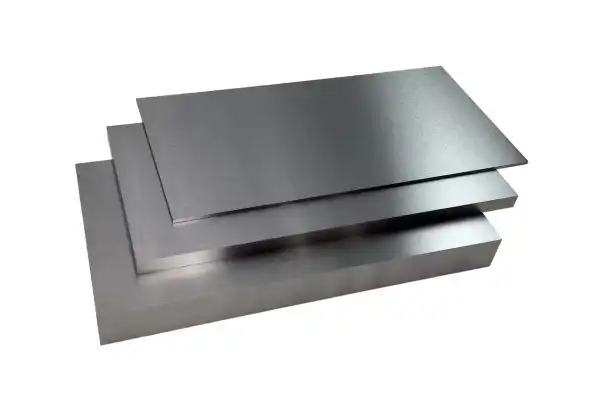
The precise peak temperature is grade-dependent. A 90% W composition typically sinters fully at 1460-1470°C, while 97% W requires 1500-1520°C to achieve adequate liquid volume because there is less binder available. Holding time at peak temperature ranges from 30 to 90 minutes. Longer holds allow more tungsten to dissolve and reprecipitate, which coarsens the grains and increases density but reduces ductility. In our production, we target a holding time that yields density above 99% of theoretical while keeping the as-sintered elongation above 5%, which is the ASTM B777 minimum for Class 1 material.
Atmosphere control is equally important. We run Ni-Fe grades under pure hydrogen with a dew point below -40°C. The hydrogen reduces any surface oxides on the tungsten particles and keeps the binder liquid clean. If the dew point rises even slightly, you will find oxide inclusions in the final microstructure—visible as small round pores on a fractured surface. For W-Ni-Cu grades, vacuum is preferred because copper vaporizes rapidly in flowing hydrogen at sintering temperature, which would alter the binder composition and lower density.
Temperature uniformity across the furnace hot zone is critical for batch consistency. A temperature gradient of more than ±10°C across a batch will produce parts with different final densities and mechanical properties. We use multi-zone heating elements and multiple thermocouples to verify uniformity before every production run. Parts placed near the heating elements can over-sinter and develop grain growth that makes them brittle, while parts in the thermal center may remain slightly undersintered with residual porosity.
The relationship between sintering conditions and final properties is direct and measurable. Sintered density is the first performance indicator. For a 93% W-Ni-Fe alloy, density should fall between 17.4 and 17.6 g/cm³—approximately 99% of theoretical. A density below 17.2 g/cm³ almost always indicates incomplete sintering, and that part will exhibit poor strength and unpredictable machinability.
The following table summarizes typical as-sintered properties for three common WHA grades under ASTM B777:
| Grade (W%) | Binder | Density (g/cm³) | UTS (MPa) | Elongation (%) | Hardness (HRC) |
|---|---|---|---|---|---|
| 90% W | Ni-Fe | 17.0-17.2 | 620-760 | 6-12 | 24-28 |
| 93% W | Ni-Fe | 17.4-17.6 | 650-800 | 5-10 | 26-30 |
| 97% W | Ni-Fe | 18.4-18.8 | 600-750 | 2-5 | 30-34 |
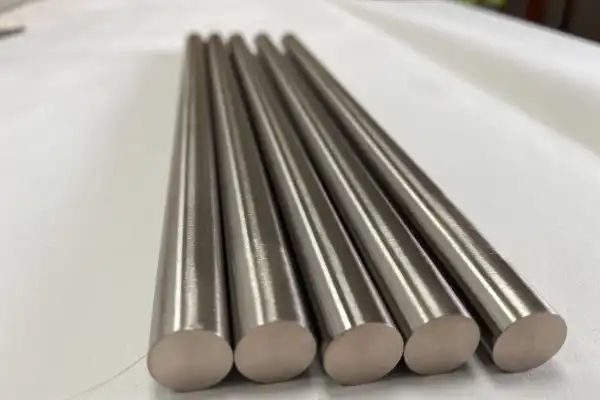
Mechanical properties are not solely determined by tungsten content. The sintering temperature and hold time directly influence grain size and tungsten-tungsten contiguity. Higher temperatures or longer holds increase contiguity—the degree to which tungsten grains touch each other—which raises hardness but reduces ductility sharply. If your application requires impact toughness, such as a counterweight in a vibration environment, you should prioritize a lower contiguity microstructure, which means careful sintering temperature selection and avoiding oversintering.
A practical tip: when specifying a WHA grade for a machined component, do not only specify the tungsten percentage and ASTM class. Ask your supplier for the expected as-sintered grain size and the sintering atmosphere used. A 93% W part sintered in hydrogen at 1470°C with a 45-minute hold will machine very differently from one sintered in vacuum at 1500°C with a 90-minute hold, even though both may meet the minimum density requirement.
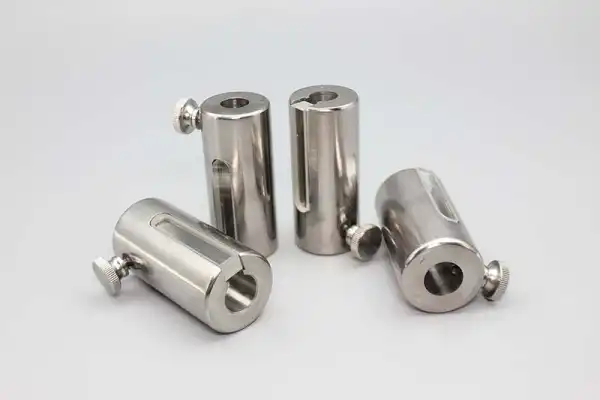
After sintering, every part should be inspected for dimensional conformance and internal integrity. We use density measurement by Archimedes principle as the primary pass/fail test because it correlates tightly with mechanical properties. For parts requiring guaranteed structural integrity—such as radiation shielding in medical devices—we supplement density testing with ultrasonic C-scan inspection to detect internal porosity or cracks that are invisible on the surface.
When sourcing tungsten heavy alloy components, verify that your supplier’s sintering process is supported by documented furnace logs and batch traceability records. An ISO 9001 certification is a baseline, but for critical applications, a supplier should be able to provide a process qualification record showing temperature and atmosphere data from the exact batch that produced your parts.
If your program involves complex geometries, thin-walled sections, or tight dimensional tolerances on as-sintered parts, it is worth confirming the specific sintering parameters with your supplier before placing an order. A poorly controlled cycle creates internal stress gradients that warp parts during cooling, and no amount of post-sinter machining can recover a distorted blank. Reach out with your part drawing and tolerance requirements at [email protected] or call +86 13995656368, and we will review the sintering profile for your component.
What is the difference between sintering W-Ni-Fe and W-Ni-Cu grades?
The binder composition drives distinct process requirements. W-Ni-Fe grades sinter well in dry hydrogen because hydrogen reduces iron oxides and the iron improves wetting of tungsten grains. W-Ni-Cu grades cannot sinter in hydrogen because copper has a high vapor pressure at 1450°C and will evaporate, leaving porous binder channels. These grades must use vacuum sintering or an inert gas atmosphere. The resulting W-Ni-Cu parts are non-magnetic and offer slightly better electrical conductivity, making them suitable for specific aerospace and electronic applications where magnetic permeability is a concern.
Can tungsten heavy alloy be sintered without a binder?
No, the liquid phase sintering of tungsten heavy alloy fundamentally requires a lower-melting binder. Pure tungsten powder alone sinters by solid-state diffusion at temperatures above 2000°C, which is impractical for production and yields only about 90-95% density. Even then, the pure tungsten part is brittle and nearly unmachinable. The ductile binder phase in WHA is what gives the material its unique combination of high density and reasonable machinability.
What causes porosity in sintered tungsten heavy alloy?
Residual porosity after sintering has three primary causes. First, insufficient liquid volume from too little binder or a sintering temperature below the full liquid phase formation threshold. Second, gas entrapment when the binder melt flows around tungsten particles and traps furnace atmosphere before the liquid can escape through interconnected channels—this is why ramp rate matters. Third, oxide contamination on tungsten powder surfaces that prevents wetting, leaving gaps that the liquid binder cannot fill. In our experience, the vast majority of porosity issues trace back to powder quality or atmosphere purity rather than the sintering temperature alone.
Does post-sintering heat treatment improve properties?
For most grades, no additional heat treatment is required beyond controlled cooling from the sintering temperature. Rapid cooling from the peak sintering temperature can suppress carbide precipitation at grain boundaries and preserve higher ductility, which some manufacturers use as a de facto quench step. However, for large parts with thick cross-sections, we recommend a moderate cooling rate of about 10-20°C per minute through the 600-900°C range to avoid thermal shock cracking. Beyond that, any post-sinter annealing or aging is application-specific and should be discussed with your supplier.
How does sintering affect machinability of tungsten heavy alloy?
Machinability is directly tied to the sintered microstructure. A fully dense, properly sintered WHA part with uniform tungsten grain distribution will machine with carbide tooling at similar cutting parameters to gray cast iron. Undersintered parts with residual porosity cause the cutting edge to alternately cut hard tungsten grains and then air pockets, which produces an intermittent cutting action that shortens tool life and yields a poor surface finish. If your machinist reports unpredictable tool wear or surface cracking on a WHA blank, porosity from incomplete sintering is the first thing to investigate. If your part geometry or tolerance class requires a specific sintering profile to optimize machinability, share your specifications and we can confirm feasibility for your program.
If you’re interested, check out these related articles:
A Domestic Pioneer In High Purity Tungsten Target Technology
Analysis Of The Outstanding Performance Of Molybdenum Copper Alloy And Cmc Three Layer Structure Materials
Unveiling The Versatile World Of Cemented Carbide Products Powering Industries Across The Globe
How To Find Reliable Chinese Titanium Pipe Distributors
Analysis Of The Outstanding Performance Of Copper Molybdenum Copper Cmc Electronic Packaging And Heat Sink Materials