
Managing heat in modern electronics keeps getting harder. Power densities climb, components shrink, and the margin for thermal error narrows with each generation. Two materials consistently surface in conversations about high-performance heat sinks: Diamond Copper composites and Tungsten Copper alloys. Both solve real problems, but they solve them differently. Having worked with these materials across various applications, the choice between them rarely comes down to a single number on a spec sheet.
Diamond Copper takes an aggressive approach to thermal conductivity. The composite embeds diamond particles within a copper matrix, exploiting diamond’s rigid covalent lattice structure. Phonons travel through diamond with minimal scattering, which translates to heat moving fast. The copper component adds electrical conductivity and enough ductility to make the material workable, though “workable” is relative here.
Tungsten Copper alloys follow a different logic. These powder-metallurgy composites blend tungsten’s density, strength, and high melting point with copper’s thermal and electrical properties. The ratio between tungsten and copper can be adjusted during manufacturing, which gives engineers a tuning knob for properties like thermal expansion and mechanical strength. Hubei Fotma produces Wcu Tungsten Copper Alloy with precisely controlled compositions, allowing thermal expansion coefficients to be matched to specific substrate materials.
| Material | Density (g/cm³) | Young’s Modulus (GPa) |
|---|---|---|
| Diamond Copper | 3.8 – 6.5 | 150 – 250 |
| WCu (70W-30Cu) | 14.5 | 320 |
| WCu (80W-20Cu) | 15.5 | 350 |
The density difference is substantial. Diamond Copper runs lighter, which matters in aerospace and portable applications. WCu’s higher density and stiffness make it structurally robust in assemblies that see mechanical stress alongside thermal loads.
Diamond Copper can exceed 600 W/mK in thermal conductivity. That number sounds impressive because it is. Diamond’s phonon transport mechanism moves heat with remarkable efficiency, and when those particles are distributed properly through a copper matrix, the composite inherits much of that capability.
WCu alloys typically land between 170 and 220 W/mK, depending on tungsten content. Higher tungsten percentages reduce thermal conductivity but increase mechanical strength and lower the thermal expansion coefficient. The material research team at Hubei Fotma, drawing on over 30 years of technical experience, controls these tradeoffs through precise process parameters during sintering and infiltration.
The gap between 600 W/mK and 200 W/mK looks decisive on paper. In practice, the relevance of that gap depends entirely on the thermal load and system constraints. A heat sink that conducts heat brilliantly but cracks due to thermal expansion mismatch has failed its primary job. Thermal conductivity matters, but it’s one variable in a system with many.
Diamond Copper earns its place in extreme heat flux scenarios where junction temperatures must be minimized at almost any cost. Wcu Tungsten Copper Alloy serves a broader range of applications where thermal performance must coexist with mechanical reliability and controlled expansion.
Diamond Copper presents genuine manufacturing challenges. Diamond particles resist bonding with most metals, and their hardness makes machining difficult. Production typically involves infiltration techniques where molten copper fills the spaces between diamond particles, or specialized brazing methods. Creating reliable Diamond Composite Materials requires tight process control and often results in higher per-unit costs.
WCu manufacturing follows more established powder metallurgy routes. Tungsten and copper powders are blended, compacted, and then either sintered at high temperature or infiltrated with molten copper. Hubei Fotma employs both approaches to produce Wcu Tungsten Copper Alloy with consistent density and uniform phase distribution. The challenge lies in achieving good metallurgical bonding between the tungsten and copper phases while minimizing porosity.
| Property | Diamond Copper (Typical) | WCu (70W-30Cu, Typical) |
|---|---|---|
| CTE (ppm/°C) | 5 – 8 | 6.5 – 9.0 |
| Hardness (HV) | 200 – 350 | 200 – 280 |
| Machinability | Difficult | Moderate |
| Manufacturing Process | Infiltration, Brazing | Sintering, Infiltration |
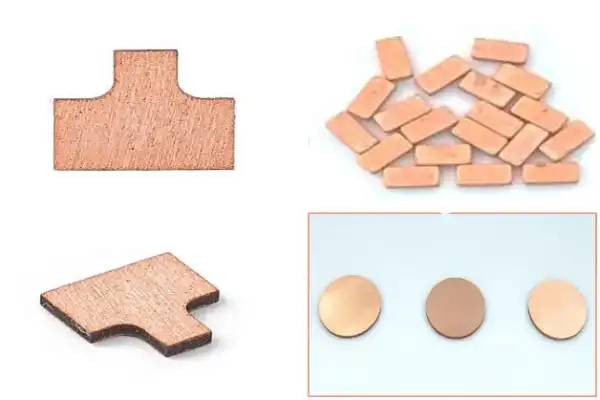
Machinability affects more than just manufacturing cost. It influences design freedom. WCu can be machined into moderately complex geometries with standard carbide tooling. Diamond Copper often requires diamond-tipped tools and slower feed rates, which limits practical complexity and increases lead times.
Electronic assemblies cycle through temperature ranges during operation. Each cycle causes materials to expand and contract. When a heat sink and a semiconductor die have mismatched coefficients of thermal expansion, stress accumulates at the interface. Over hundreds or thousands of cycles, that stress causes solder joints to crack, die attach materials to delaminate, and devices to fail.
Diamond Copper’s CTE falls in the 5 to 8 ppm/°C range, which works well with certain semiconductor materials but may still require careful interface design. The real advantage of Wcu Tungsten Copper Alloy lies in its adjustability. By changing the tungsten-to-copper ratio, the CTE can be tuned to closely match GaAs, SiC, AlN, or other common substrate materials. A 70W-30Cu composition might suit one application while an 80W-20Cu composition better matches another.
This tunability makes WCu particularly valuable in power electronics where silicon or silicon carbide devices mount directly to heat spreaders. The ability to minimize thermal stress extends device lifespan and reduces field failure rates.
Diamond Copper finds its strongest applications in scenarios where thermal conductivity dominates all other considerations. High-power laser diodes generate intense, localized heat that must be removed quickly to prevent junction temperature rise. In these applications, Diamond Copper’s ability to conduct heat away from a small active area can meaningfully extend device life and allow higher operating powers.
Aerospace thermal solutions also favor Diamond Copper when weight constraints are severe. The material’s lower density compared to WCu translates to mass savings in satellite and aircraft systems where every gram carries a cost penalty.
Wcu Tungsten Copper Alloy serves a broader application base. Power modules use WCu as igbt heat sink substrates and heat spreaders because the material handles high thermal loads while matching the expansion characteristics of ceramic substrates like DBC or AMB. LED thermal management benefits from WCu’s combination of good thermal conductivity and mechanical stability. Semiconductor packaging relies on WCu for similar reasons.
The question of which material “outperforms” the other depends entirely on what performance means in a given context. Diamond Copper wins on raw thermal conductivity. WCu wins on versatility, manufacturability, and cost-effectiveness across a wider range of applications.
Diamond Copper costs significantly more than WCu. Synthetic diamond particles are expensive, and the manufacturing processes required to create reliable composites add further cost. Per unit volume, Diamond Copper can run several times the price of comparable WCu components.
That cost premium makes sense only when the thermal performance advantage translates into measurable system benefits. If Diamond Copper allows a laser to operate at higher power without degradation, or enables a satellite component to survive a thermal environment that would destroy alternatives, the investment may be justified. If a WCu heat sink meets thermal requirements with acceptable margin, the additional expense of Diamond Copper delivers no practical return.
Wcu Tungsten Copper Alloy occupies a favorable position for high-volume applications. Raw material costs are lower, manufacturing processes are mature, and the material can be sourced from multiple qualified suppliers. Power electronics and LED lighting markets, where cost pressure is constant, lean heavily toward WCu for these reasons.
Research continues on materials that might combine Diamond Copper’s thermal conductivity with WCu’s manufacturability. Carbon nanotube composites and graphene-enhanced metals show promise in laboratory settings, though scaling these to production volumes remains challenging. Additive manufacturing opens possibilities for heat sink geometries that were previously impractical, potentially improving thermal performance through design rather than material selection alone.
Hubei Fotma maintains active research programs exploring new non-ferrous metal compositions and processing methods. The goal is to expand the range of thermal and mechanical properties available to designers while keeping manufacturing practical and costs reasonable.
Hubei Fotma Machinery Co., Ltd. specializes in tungsten-molybdenum products, Wcu Tungsten Copper Alloy, and related non-ferrous metal solutions. Over 30 years of technical development have built deep expertise in powder metallurgy, sintering, and infiltration processes. The company holds ISO-9000-1:2008 certification and operates modern production facilities capable of meeting demanding specifications.
For projects requiring custom thermal management materials, Hubei Fotma’s engineering team can work through specific requirements and recommend appropriate compositions and processes. Contact [email protected] or [email protected], or call +86 13995656368 or +86 13907199894 to discuss your application.
Diamond Copper makes economic sense when thermal conductivity directly limits system performance and no alternative material can meet requirements. High-power laser diodes, compact aerospace electronics, and certain defense applications fall into this category. The material’s ability to move heat quickly from small, high-flux areas can enable higher operating powers or longer device lifetimes that offset the material cost. For applications where WCu or other materials provide adequate thermal margin, Diamond Copper’s premium typically cannot be justified.
Quality control begins with raw material selection and continues through every process step. Powder characteristics, blending uniformity, compaction pressure, sintering temperature profiles, and infiltration parameters all receive monitoring and documentation. Final inspection includes density measurement, metallographic examination, and thermal property verification. The ISO-9000-1:2008 certified quality system ensures that Wcu Tungsten Copper Alloy components meet specified thermal expansion coefficients and mechanical properties consistently across production lots.
WCu offers advantages when thermal expansion matching matters as much as thermal conductivity. Power electronics mounting silicon or silicon carbide devices benefit from WCu’s tunable CTE, which can be adjusted to minimize interface stress. Applications requiring moderate machining complexity favor WCu’s better workability. High-volume production runs benefit from WCu’s lower material and processing costs. LED packaging, igbt heat sink substrates, and microwave device housings commonly specify WCu for these reasons.
Yes. The company’s material research team works with customers to define target properties including thermal conductivity, CTE, density, and mechanical strength. Custom Wcu Tungsten Copper Alloy compositions can be developed by adjusting the tungsten-to-copper ratio and optimizing process parameters. This capability extends to other non-ferrous metal systems including tungsten-molybdenum products and specialized composites for demanding thermal, mechanical, or environmental conditions.